Nachrichten / 17 Jun 2016
Gehe zu NachrichtenEuropean Left starts working on a European Conference on Debt
Proposals to fight the debt, used as a political weapon against the people
The Party of the European Left (EL) is working, for a year now, in the Alliance Against Austerity and for even longer in the construction of a broader alliance to fight the troika and their neoliberal politics. For next year, the EL is preparing a European Conference on Debt but a preparatory seminar for its organization already took place this past 11th of June.
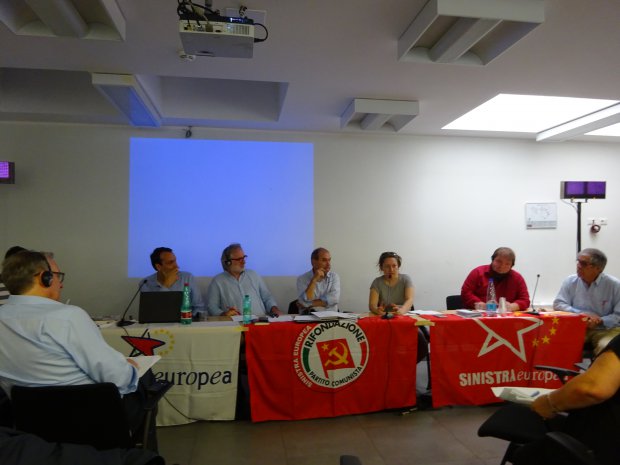
The seminar, organized by the European Left and the Communist Refoundation Party (PRC), was held in Rome and it were the Italians who introduced and launched the debate journey. It started by identifying the root cause of the problem, its origin and how the private debt – used to rescue the financial institutions -, was converted into public debt. The main discussion was also focused on how the debt is being used as a weapon against the people and its political use to legitimize austerity and exploit the commitments made in the process of indebtedness.
To address this question, the economic responsible of PRC, Roberta Fantozzi, spoke on the need to deconstruct the dominant narrative and propose alternatives. “If we change the terminology and the dominant point of view we will see the problems from a different perspective and we could solve them differently”. This is what was done during this whole journey. There was a talk on overturning the fiscal policy, on printing more money to invest in a plan to create employment in a large scale, in progressive fiscal policies, in constructing a strong front against the Fiscal Pact and on how to coordinate the different initiatives that Europe is facing, because the alternative, as it was debated, must have a European scope.
The Italian economists Giovanni Mazzetti and Louis Pandolfi, together with the afternoon speakers, brought to the table issues that already have a long history, such as the democratization of the European Central Bank and the need to restructure the debt and end austerity, which far from solving the crisis only globalises instability. Other issues were also addressed, such as how the inflation is never a problem since what it does is to make money circulate, because no one wants to keep it in their pockets for it to lose value. At some moment it was even remembered that it was precisely the deflation paving Hitler’s way to power. And it was also said that capitalism wants the crisis because it serves to give a lesson to the workers and also because if the crisis didn’t exist there wouldn't be interests either.
All of them agreed that we must invest in public expenditure because it has a multiplier effect and creates interrelationships. The crisis, was said, doesn’t exist because resources were spent but because of the kind of relations. In this regard, the less money circulates, less workers there will be. The speakers also presented less known debt perspectives, like although much is said about the debts in Greece, Spain and Portugal, those together only represent 17% of the European debt (with Spain having the biggest percentage), with 1.403.552 million euros, while the debts of France, Germany and Italy, together, sum almost 70%. And also, that the majority of the debt is in foreign hands, three-fourths in the Italian case. And the main beneficiaries are corporations.
Proposals to solve to problem of the debt
French economist Frederic Boccara defended that there is only one solution to fight the financial crisis and now the fear of deflation, which is creating more money: “the European Central Bank must print money to finance the public services”. Up until now, capitalism uses the money to create capital, to have more money, but not to invest in development and for the people to benefit from it. He explained that we must do a non-conventional monetary policy.
He started with the idea that a new European treaty is necessary, but because that takes time we have to act in the meanwhile. How?, he asked. In many ways: through the monetarisation of the debt; reducing it and cancelling the interests, since a big part of the debt is acquired by paying interests; creating a European Fund for Public Services; and investing in the production of companies. The Fund, he added, could be created now and finance directly the States so every country could develop its social services at a 0% interest.
And we must also help companies because they are the ones generating employment. They would be helped at a 0% interest if they create employment and protect the environment. The money, he argued, must go to the real economy and not to the financial markets.
In fact, according to Gabrielle Pastrello, the question is where to put the money: if in speculation, in investment and production or in consumption.
In the same line that Boccara, Stefano Candela outlined the principles of “Quantitative Easing for People”, based in the idea that the money has to go to the people and not to the financial institutions. The procedure is that the ECB creates money to buy debt to the financial institutions and those ones give low interest credit to the people and companies to increase production and reactivate the economy.
From Spain, Javier Navascués, argued that “the debt is a debt of capitalists, not of the workers” and exemplified with the public debt audits that were being developed at municipal level in those “municipalities of change” like Madrid. In those audits, the origin of the debt is being unmasked and the people will see where there problem is coming for. He also talked about to tributary exploitation being done is the majority of capitalist states, where workers pay in excess for what they receive.
The trade unions emphasis came from Matthew Méaulle, from ETUC, who explained that the priorities of the European trade union is to fight austerity in favour of public investment, since if the private sector does not do his job, the public has to come forward.
Giorgios Chondros spoke on the frustrating experience of fighting against austerity in Greece and the need to fight together to avoid the isolation they lived and for that he defended the Alliance Against Austerity as a “survival method”, asking to concretize the theory in the daily struggle and assuming that “is inevitable to change Europe from the inside”.
Who also spoke on unifying the different struggles against austerity was Martin Guenther, from Die Linke, in what he called “building camps of solidarity”. One of these fights is precisely the battle against the TTIP, which is developing with so much strength in Germany with the majority of the people being against this Free Trade Agreement between the United States and Germany.
It was then the Italian MEP Eleonora Forenza, from L’Altra Europa con Tsipras, who explained the details and consequences of TTIP and how the debt is “a way to take sovereignty from us”.
Paulo Ferraro, Secretary-General of the Communist Refoundation Party closed the debate and Pierre Laurent made the final remarks closing the seminar.
Original Language / EN