Actualités / 08 déc. 2015
Aller aux actualités‘Sacrificing freedoms would be granting a victory to Daesh’
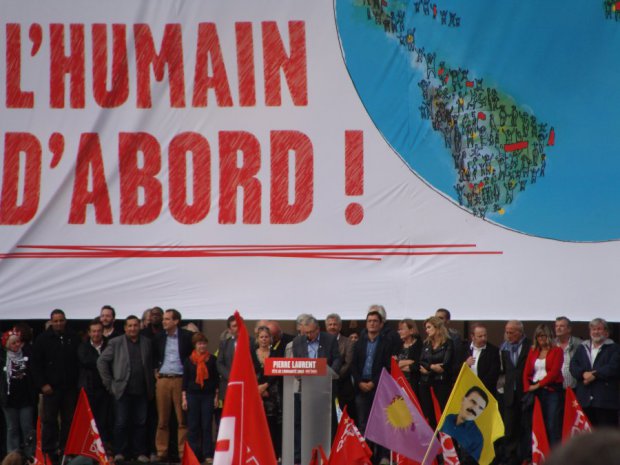
In a comprehensive interview with Onur Erem from BirGun newspaper, Party of the European Left President and French Communist Party General Secretary Pierre Laurent talks about the future of France, state of emergency in the country, the ways of struggle against radical Islam and extreme right, the refugee crisis, Middle East policies of France and elections:
- How can you describe the general situation in France after the Paris attacks?
The shock of these murders has given rise to an enormous swell of emotion around the country. The dignity and courage of the popular reaction has been remarkable. I am proud to be part of this nation that has been able to react so calmly, and to express such a will to carry on with life. But this reaction is also tinged with a new kind of worry, much more evident than after the attack on cartoonists at Charlie Hebdo last January, because Daesh (a.k.a. ISIS, ISIL) violence is blind may strike anyone.
The people have risen to the occasion, but they are vulnerable. It is important at such times for those of us who believe in fraternité to take good care of those who have suffered and are vulnerable, and to work to keep the people united. We must be vigilant in stopping violent speech that fans the flames of hatred.
- How do you evaluate the reaction of the French government after the attack?
François Hollande first of all stayed with current logic by intensifying French strikes in Syria, without demonstrating their effectiveness. At the same time, he in fact recognized that that the successive western and Russian interventions have been disorganized and have led us to a dead-end. He called on the United Nations to act, and for a new coordination of international strategies. Better late than never. We should emphasize that this is the first time in five years that there has been an agreement to find a political, and not only military solution to the Syrian conflict.
- Do you think that bombing Syria more than before is an effective way to struggle against radical Islamism? If you don't agree with this policy, what kind of struggle do you recommend? What should be done against radical Islam in the short and the long term?
Fighting back against violence by military means alone and with no political strategy aimed at restoring peace and promoting development in the whole region would be a serious mistake. France must learn lessons from the past and seriously reconsider the foreign policy choices we have made in the Near and Middle East and Africa for decades.
We must prepare for a complete change of paradigm, and new choices are to be made today. France must take initiatives to contribute to a multi-lateral, international effort under the auspices of the UN, so that the people of the region can take back control of their resources and wealth, rebuild their States on a foundation of rule of law and democracy, with respect for sovereignty. This is necessary for the greater good of all peoples of the world.
International involvement should support the regional forces that can help build these sustainable solutions. I am thinking in particular of the Kurdish forces and also democratic forces in Syria and Iraq, which have been shunted aside as the forces in favour of war have grown stronger. France must play an active role in discussions in Vienna concerning political solutions and the rebuilding of States in the region. On an economic level, the financial and oil revenues that are now held by Daesh must be dried up; a plan for aid and development with a view to establishing the necessary regional framework for cooperation and security is needed.
- Extreme right wing politicians are using these attacks to widen their base and influence. There have been attacks against the immigrants after the massacres. What should be done in order to save French people from potentially racist influences coming from the right? What responsibility should the left assume in countering these influences?
Warmongering, fear mongering and racism from the right and the far right must be condemned and combated resolutely. The government cannot stand by idly. For Communists, there is no room for equivocation: any form of stigmatisation or suspicion in our country towards Muslims must be condemned firmly and with determination. Any physical or verbal aggression of a racist or xenophobic nature is an aggression against all the people of France.
We cannot accept that refugees in France and Europe serve as scapegoats for terrorism when they are in fact the first victims of Daesh, the Syrian regime and war in general. This odious stereotyping is not only false, but dangerous. The right of asylum must be fully respected in France and in Europe.
- Like many other countries including the USA and Turkey, France has been supporting various armed groups in Syria and this support has contributed to the situation in Syria, enabling the IS to take root. What's your comment on the role of French policies with regard to the attacks?
Since the beginning of the conflict in Syria, France has been focused solely on the logic of war. As of October 2011, it was the only country to recognize the Syrian National Council. This organisation, initially based in Turkey, is under the thumb of the Muslim Brotherhood and the Gulf monarchies. Some of the funds given to the SNC by Paris went directly to Salafist groups. In addition, France, along with the United States, Qatar and Turkey, armed the Free Syrian Army. In 2013, the FSA entered an alliance with the Al-Nosra Front (an Al Qaida affiliate). Several months later, the Islamic front and the IS took over the arsenal. The SNC, the main force within the National Coalition for Syrian Revolution and Opposition Forces, and has little power in the region, thus limiting the capacity of France to influence a dynamic for peace. F. Hollande has consistently refused to support the Kurds of the PYD (Democratic Union Party), despite the repeated requests of the French Communist Party. No arms were delivered to the fighters in Kobane because we didn't want to displease Turkey. And yet the Kurds are currently the only democratic forces fighting Daesh in the field.
- It is said that the Muslim minority in France is growing up in alienation and poverty, which makes them vulnerable to Islamist propaganda. How should these problems in ghettos be solved? Did any of the recent administrations take any steps to tackle this problem?
First of all, I want to say that we must avoid stereotypes and clichés. Some would push the country towards more divisions and even conflict. French society resists "communitarianism", and that is a good thing from our point of view. We are actively working to ensure that in no case should French Muslims, or foreigners from North Africa, Africa or the Middle East who live in our country be held responsible for terrorist violence. It is right to underscore that social difficulties and inequity are among the causes of the divisions that weaken France, that many French Muslims or those categorized as such suffer from this social context, and that religious fundamentalists and sect leaders feed on these divisions. But there is no automatic link. All sorts of youth are drawn into the web of radicalisation, not only the underprivileged; 20% of those who are most likely to fall into the horrors of terrorism are converts who have been converted by radical Islamists.
Our people, all of the people of France, cherish the founding values of our Republic and secularism. This is true of those who have religious beliefs and those who do not. Since the attacks in January and November, we have all become aware that French society has to reconsider the world of violence, war and chaos we live in; the state of our society where young people do not find their place; a society that seems meaningless to some youth; where the ultimate value is money; where the worst kinds of violence are glorified. Individualism and racism in all forms, the reduction of public services, discrimination in housing and employment – often both at once – are the daily reality for the working class. We are also paying the price for years of austerity policies that have widened inequalities in our country. When Prime Minister Valls speaks of "social apartheid", and others of "ghettos", this signifies a willing abandonment of whole groups of society. We, on the other hand, believe in a stronger republic, more public services, ambitious cultural, educational and sports policies. French society needs to build up collective, liberating hope and support struggles for freedom. The current government is not going down this road. The regional election in December will be the time for us to mobilise all citizens who would like to live in a society that stands up for its youth, respects and values young people.
- The state of emergency in France has been extended for three more months and there are worries that it can turn into a tool of oppression by the system. Recently French historian Anthony Crezegut declared his concerns on this topic. Also François Hollande said that the powers of the police and the gendarmerie should be increased. What do you think about these debates?
We approved the declaration of the state of emergency in the hours following the attacks. Its extension includes some restrictions of public freedoms, which can only be accepted on a very temporary basis. A twelve-date state of emergency was justified by the gravity of the attacks. In this high-risk period, an extension of the state of emergency may be considered, but it must be limited and controlled, for example by a parliamentary review every two weeks. We suggest that the National Assembly should establish a democratic control mechanism, because three months is a long time and serious problems in regard to the respect of basic rights may be raised.
However, we are formally opposed to a revision of the Constitution that would enable an unlimited state of emergency.
The safety of all is a priority and must be ensured, while necessarily protecting the freedoms and basic rights that are the foundation of our Republic. Sacrificing some freedoms would be a granting a victory to the Daesh terrorists.
Speaking of security, the first step to take is to increase the human resources of the police, the gendarmerie, the customs authorities, in-country defence, and all public services; this is the key to improving our system of security.
- How can the Paris attack affect the regional and presidential elections?
Regional elections will be held this December 6th and 13th in a post-traumatic period and under the exceptional circumstances of the state of emergency. The nature of the election has thus changed. It has taken on a national importance, far beyond issues of regional politics. When I attend rallies for the list I am on, I discern that people need very much to talk, to understand and to be reassured.
A lot will happen before the presidential elections of 2017. The current president has announced a constitutional revision. What will be the state of the world, the state of war? It is unreasonable to speculate on 2017 at this time. What is clear is that our approach will be to build a project for peace and human development for France, with all available democratic, political and social forces.
- Do you think the European Union and France should change asylum and refugee policies? If so, how?
The European Union and the Member States have decided to carry out a policy of turning back migrants and dissuading all hope of welcome on our continent. They should think about their own responsibility in creating the conditions that have led these men and women to flee violence and poverty in their countries of origin.
Fortunately, in France and Europe, there are citizens, associations, trade unions and political groups that are working to help welcome these refugees with the dignity they deserve; these same people are also working for a world of peace, development and respect of human rights, the only path towards societies based on solidarity and sharing. French Communists and their elected representatives remain committed to solidarity with the migrants and call for the implementation of emergency measures: respect of the Geneva Convention, adjustment of Frontex missions, repeal of the Dublin directive and the "Balladur visa", and the creation of appropriate structures for receiving the migrants.
(26.11.2015, by Onur Erem)
Original Language / EN