Actualités / 04 nov. 2015
Aller aux actualitésHow create counter-power to build another Europe was debated at the Fiesta del PCE
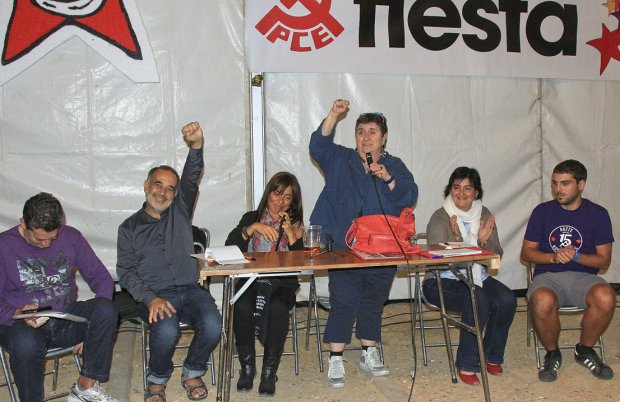
The future of Europe and what to do after the Greek defeat, is the axis of reflection about the European project of the left. That was the issue discussed at the Fiesta of PCE where Maite Mola, Vice President and head of international policy of the Party of the European Left (EL) addressed the debate asking very specific questions to each of the participants.
To the question of what to do after the capitulation of Greece, responsible for international policy of the French Communist Party (PCF), Lydia Smarbakhsh, drew the political landscape with the three conceptions that confront today in Europe: the ultra-neoliberalism, the nationalism and xenophobic forces, and the forces of lefts that want the European Union to be the union of the solidary, free and associate peoples.
"The Greek political failure has served to put on the agenda the blackmail of the debt against the sovereignty of peoples," said the French leader. "From our point of view we must give the ideological battle at European level to defend our values" and summed up in three points the ones which could create the counter-power of the left. The first one, the battle against the policy of austerity, which is developping in countries such as France, the demonstrations that are taking place in Finland and the leadership of Jeremy Corbin at the head of the Labour Party in the United Kingdom, for example. Secondly, the issue of debt and the struggle for its restructuring to revive the economy and public services that have been destroyed with the excuse of the debt. And finally, the power of the people to decide on politic issues, that is to say, the issue of democracy, as one of the bases of the mass mobilizations that have to be put in place.
Javier Navascués, Professor of the University of Seville and member of the executive of the PCE, had to reply if it is possible to move forward with the debt. His answer was that "debt is a trap to have strangled a country and the only thing that we can do with it is to denounce it (...) It is a mechanism of pressure against the peoples to prevent the States to govern".
He recalled that “when the Troika was negotiating, between quotation marks, the debt to Greece, they knew that the hellenic country would be unable to pay it (…) because the Greek debt will not be paid in the whole life and the Portuguese probably either”. He added that debts always have been condoned, as they have just done with Ukraine, but the forces of power want to keep countries prisoners of debt to be able to continue maintaining their status quo.
Disobedience
Navascués argued that the problem is not so much in debt, "which is only a chapter more" but in the entire set of policies that have been assumed. "That's why the left should disobey not only the payment of the debt, but the rest of the measures".
Stefano Galieni, who spoke on behalf of the Communist Refoundation Party, was asked if, from the italian perspective, Europe has a future. His response was that with this Europe it is not possible to change. "It's not democratic. They have demonstrated it with Greece where they have staged a coup d'etat, not with weapons but with banks". But the national states alone cannot change, he explained: "It is important to make the revolution, but if the revolution comes to Italy but not to Spain and other countries... If the class struggle does not increase in France, Italy, Germany, etc, it will not be possible to change, as they have shown with Greece." He concluded by stating that there is a 10% of the population that has enriched by the capitalism and the remaining 90% will have to fight or starve.
Adoración Guamán, Professor of labour law at the University of Valencia and Director of the Foundation of Europe of Citizens, was the one who had to introduce the proposals that left should give. The priority, she said, is to "generate a climate of opinion that breaks the myth of this European Union, which is absolutely incompatible with democracy. "That is no longer seen as a democratic club we wish to belong to and the social majorities has to identify those responsible for what is happening."
She explained that what happened in Greece has not been a failure, but the victory of a people subjected with the gun in the neck and that the case of Greece has opened a window of opportunity, because it has been shown that in this European Union we cannot do anything "even if we have the ballot box and also the mobilizations".
In the same way, the problem is not the TTIP, but the European Union; is not refugees but the migration policy of the European Union; and the problem is not unemployment but the European Union employment policy, Guamán said. She added that the criticism is necessary so that the social majorities accept that with this European Union we are going to have neither social transformation nor a life worth living.
Guamán concluded by saying that today there is no dichotomy between the nation and the European Union, as the State no longer exists as such "because we don't have full sovereignty to negotiate our rights". Navascués pointed out that "they have removed economic, monetary and financial sovereignty to national Governments to take it to the European institutions"
Original Language / EN