Actualités / 11 juin 2015
Aller aux actualitésDeclaration in the framework of the second EU-ECLAC (CELAC) Summit
Those of us who gathered last January in the I Forum of the South of Europe consider the II Encounter of EU Member States' Heads of State and Government and the Community of Latin America and the Caribbean States meeting on the next 10th and 11th of June in Brussels, under the motto "Modelling our common future: working towards prosperous, cohesive and sustainable societies for our citizens", as a good opportunity to value some of the ideas that give a sense to the construction of solidarity and horizontal relationships among the peoples of our Planet.
This Encounter should mean an advance in the social, cultural and economic relations in favour of a sustainable development which places the general interest above the business pretensions of multinational companies, thus allowing a true and equal dialogue focused on the construction of a real cooperation project which enables development.
We do not share the EU's approach regarding negotiations based on its own neo-colonialist interests which search the consolidation of competitiveness favouring multinationals and neoliberal politics which have proved to be a failure in all Latin America and the protection of its investments that reminds us of a type of colonialism which should be overcome.
In this moment we consider it necessary to add our voice in favour of the demands for more social justice, a better environmental balance and international relations based on mutual respect.
The deep systemic crisis peoples of the so called first world are undergoing is affecting the rest of the planet and specifically the peoples of Latin America and the Caribbean.
In Europe we have already denounced how this crisis is being used by those in power to implement structural adjustment policies imposing the deregulation of employment and the lowering of salaries together with tax policies which benefit large companies and the financial sector. Precarious employment is legislated and social and labour rights are eliminated.
The life quality of the majority of the population is degraded so that a minority can maintain their privileges.
These same policies foster the emergence of racism and xenophobia which imply the return to certain ideologies conducting humanity to the experience of horror during Nazism and fascism and their after-math as is the case of dictatorships in the South of Europe.
In Latin America and the Caribbean we are witnessing a process of integration producing a clear cut regarding the times of the Washington consensus that caused so much pain and misery to millions of people by means of the same imposed policies which the Troika today is starting to apply in Europe.
An important number of countries have elected progressive governments who are successfully developing policies in favour of human beings, creating employment, improving social protection and implementing social policies helping millions out of poverty.
Social justice and the redistribution of produced wealth have favoured hope and enthusiasm in millions of people.
Debt has been renegotiated in a substantial manner or subjected to audits showing the feasibility of different solutions from those imposed on European people with no consideration of the human costs and with the only concern of satisfying the demands of the financial sector responsible for a great part of the present situation.
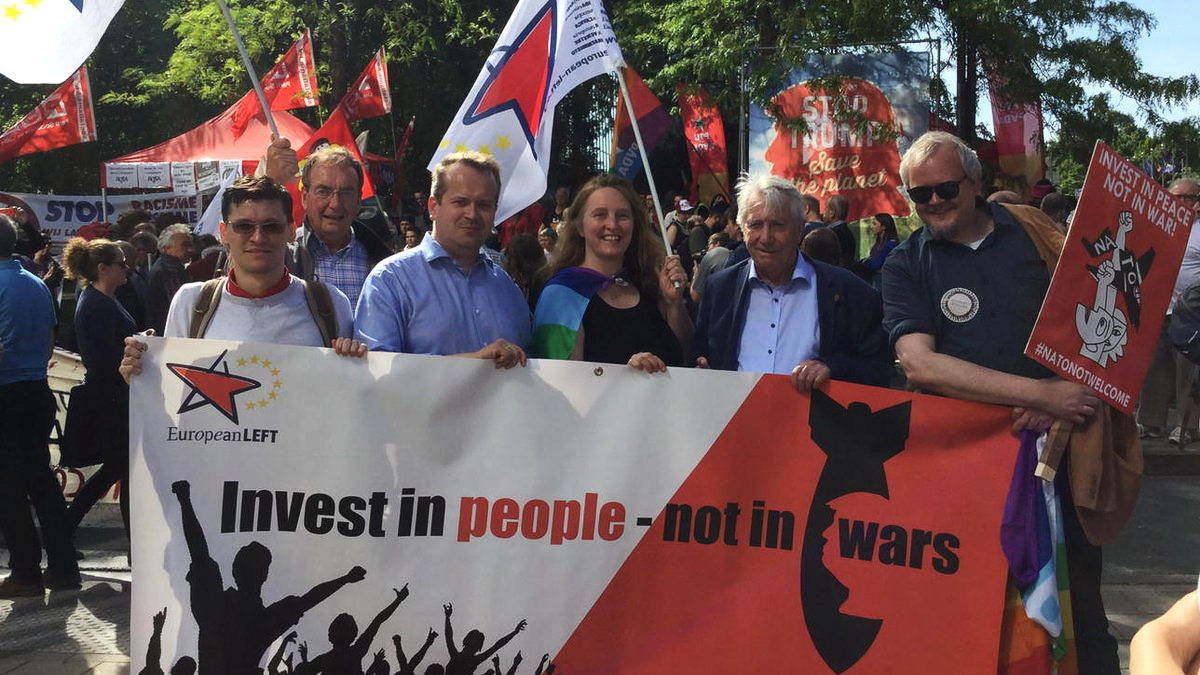
In this context we are very concerned about the degree of violence exerted in different areas of the world and we denounce the use of the NATO as a war instrument. We call for the resolution of conflicts based on a dialogue between parts excluding violence.
We consider the increase of military interventions and the dominance of interference policies as factors which are deepening and exacerbating divisions between peoples.
The European Union by submitting its international politics to the NATO reinforces militarization of the international relations and denies itself the possibility of acting as an autonomous and proposing voice to promote peace.
We highlight the agreement which proclaims Latin America and the Caribbean territory as a zone of peace and free of massive destruction weapons with emphasis on the peaceful resolution of two great conflicts in this region: the Colombian conflict and the US intention of dominating Cuba according to their policies.
We welcome the steps given in order to achieve the normalization of the relations between Cuba and the US but we consider urgent to end the blockade as an instrument of interference and aggression opposed to international laws and we demand the compliance with UN resolutions; thus, we believe it senseless to maintain the so called common position which places the EU in an even more restrictive position than that of the US.
In the same way we welcome and value positively the dialogue between the FARC and the Colombian Government in support of a status of fair and democratic peace which guarantees social justice and political participation.
We call for really active politics in the EU regarding the above mentioned issues as a new model for fair international relations based on solidarity.
In that sense we share the position stated by the ECLAC (CELAC) regarding Venezuela in opposition to Barack Obama's executive decree declaring this country as a threat to US security.
Against neo-colonialism and militarism in international relations we stand for multilateral relations between Europe and Latin America enabling closer relationships between peoples together with politics of cooperation focused on human development, social justice and actions for peace and disarmament.
All type of relations and agreements must be respectful of each peoples' right to decide on what way to achieve development and protection of the environment.
We reject negotiations of agreements and free trade treaties which in an obscure way are being established with the US and are damaging for the betterment of relations between Europe and Latin America in the sense that the EU is being subjected to a great market according to the interests of the US.
On the other hand, we believe the EU and the ECLAC must converge to support initiatives which enable the creation of instruments that regulate and restructure sovereign debts as well as the implementation of a legally binding international instrument in terms of human rights for transnational corporations and other companies.
Trade between Latin America and the Caribbean and the EU should be a force of development and not a way of imposing a relation which is destructive and unequal for national industries.
A really effective measure to favour the struggle against climate change demands a redefinition of the function of trade within developmental policies. The rules of international trade have been defined to benefit the great conglomerates that produce and export ignoring the right of every human being to live respecting the environment.
We reject the logic of domination underlying those proposals advanced in the frameworks of the Transatlantic and Transpacific Treaties.
We claim the need of convergence between European and Latin American countries in the COP-21 meeting taking place next December in Paris. This convergence will allow an agreement about the strategy against climate change as it is urgent due to the consequences we are suffering all over the Planet.
We defend the need of a true political dialogue between The EU and the ECLAC in order to impulse actions in favour of a Non-proliferation Treaty in a process of negotiated disarmament to contribute to the development of integration processes based on justice and solidarity. For this we welcome initiatives in that sense coordinated by social movements these days and we state our will to continue developing initiatives to agree on a meeting place for those who consider ourselves social and political forces of progress.
Signatories: SYRIZA, Izquierda Unida ; Partito della Rifondazione Comunista ; Iniciativa per Catalunya Verds ; MdM Movimiento de Mujeres ; Plataforma Antifracking Comarques de Castellón ; Sinistra ecologia y Libertá
Original Language / EN