Nachrichten / 21 Sep 2014
Gehe zu NachrichtenThe key to fight the increase of the far right consists in strengthening the political profile of the left
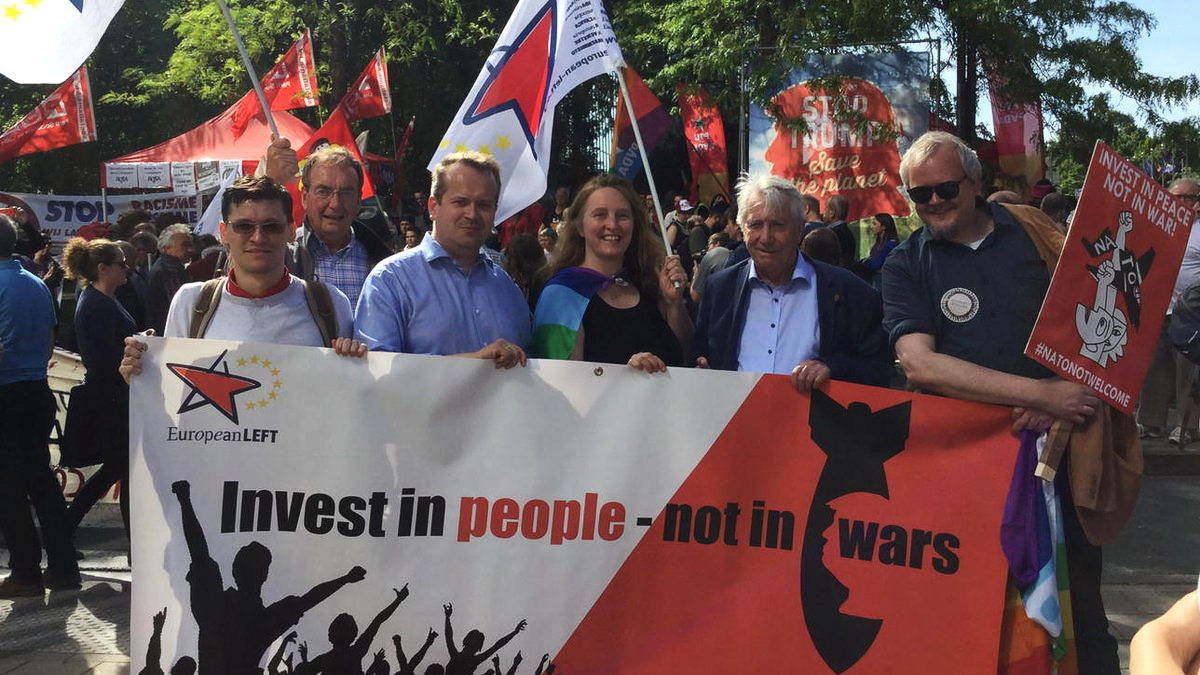
The Party of the European Left (EL) analysed, in the framework of the PCE-Festival, outlook on a European level after the European elections, showing an increase of the left which – on one hand - strengthened the GUE/NGL parliamentary group, passing from 34 to 52 members, but also – on the other hand - with a "worrisome" rise of extreme right forces. Against this backdrop the debate "Europe after the 25-M: general debate on the increase in forces of the extreme right" took place. In words of the MEP of Izquierda Unida (IU – United Left) Paloma López, who moderated the event, this rise increases the divide between the countries of the North and South, which undermines the principle of unity, being the aim of the construction project of the European Union. Paloma López defined it as the “selfishness of well-being" of the countries of the North, with a welfare state stronger than Southern countries, which are in turn suffering cuts and austerity policies.
Three examples were discussed at the event: the disconcerting rise of the National Front in France; the rise of Golden Dawn in Greece, despite some of its members being held in prison for their involvement in the murder of singer Pablo Fissas a year ago by members of the organization; and in Germany the emergence of Alternative for Germany, a conservative party which is a reference to the extreme right and achieved 7% of votes in the European elections on May 25, resulting in a representation of 7 MEPS, and which improved its results in the regional elections, reaching 10-12 %.
Among the conclusions of the debate, all the speakers agreed on the need of working at European level, not just nationally, and that the key to combat the rise of the far right is to strengthen the political profile of the left, as stated the responsible for international relations of Die Linke, Heinz Bierbaum: "We have to make very clear the political differences between the left and right by highlighting our values of democracy, solidarity and internationalism".
Gilles Garnier of French Communist Party (PCF) explained how and when the National Front, which in its 40 years of history used to achieve 1% of the votes, started to grow in 1984 when the socialist party in the government began to make cuts, as it has happened now, after ten years of government of the right and two of the Socialist Party. He added, that the way to combat the National Front is by questioning them on economic and policy issues which are the ones that bother them and in doing so diminish their credibility.
Greece is the example that an alternative to capitalism is possible. Panayota Maniou, member of the Syriza delegation to the European Parliament, recalled that for its first time Syriza governs in the region of Attica, where half of the country's population lives and half of the Greek production is generated. She added that the right wing power has played - economically, politically and in media communication - the theory of the two extremes, demonizing Syriza and instilling the fear of communism. Panayota stressed that "the discredit of democracy nourishes the extreme right" in the same form that "anti-European discourse separates us from the people, not Barroso".
The Vice President of the Party of the European Left (EL), Maite Mola, pointed to another worrisome element of results of the last European elections: "the winner has been the abstention," she said, adding that it is an element to be analysed and which is attached to the deideologisation and the deliberately planned increase of authoritarianism. She recalled also that the Italian Prime Minister Matteo Renzi, a referent for the new Spanish Socialist leader Pedro Sánchez, governs Italy without having pass a vote through the ballot box.
Finally, Maite Mola emphasised the importance of Alexis Tsipras’ candidacy to the European Commission, "because it showed that there is an alternative force; he spoke about reviewing the debt, the creation of a public bank and employment... it gave us the chance to explain that there are other options to neoliberalism".
Original Language / EN