Nachrichten / 16 Mär 2006
Gehe zu Nachrichten18th of March, International Action Day against War and Occupation in Iraq
The continuing occupation, of Iraq, three years after the illegal and barbarous war, feeds a vicious circle of violence and bloodshed. The martyred people of Iraq experience an endless tragedy, after their heavy suffering from successive wars, the tyranny of Sadam Hussein and the international embargo against his regime.
Based on lies, the war on Iraq was part of the hegemonic and militaristic plans of the U.S. Administration pursued in the framework of the neoliberal capitalist globalization. These aims are served by the so-called “war on terror” which tends to be a permanent war on the whole world. As a result, a new shift to militarism is taking place, as evidenced by the fact that the world military spending has been more than 1 billion dollars in 2004.
The war on Iraq was an event of global impact. The informal alliance of the US with European countries and the implementation of their plans based on the “preventive war” doctrine brought to the fore the great dangers to world peace.
The magnificent antiwar movement, which developed and was coordinated globally, played an important role not only in mobilizing people, but also in influencing political developments, as was shown by the governmental change in Spain and its military withdrawal from Iraq and subsequent withdrawals of a number of European countries. This movement drew strength and momentum from the previous mobilizations against the neoliberal globalization and from the active support of the World Social Forum and the European Social Forum.
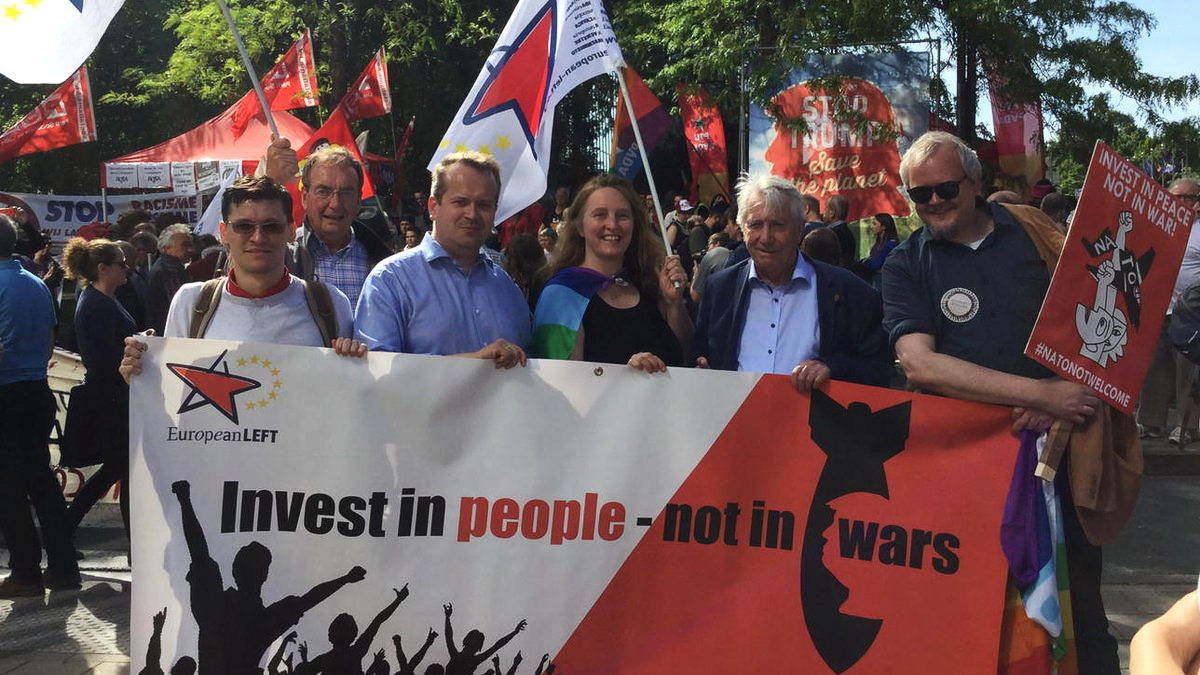
The European Left as a whole was against the war from the beginning and contributed decisively to the anti-war mobilization.
The results of the war and occupation of Iraq constitute a shameful political and moral defeat for the Bush administration and Mr. Blair.
It provided new ground for terrorism to expand instead of leading to its elimination. It fuelled the theory of the “clash of civilizations” and in particular its extremely dangerous version of “Islam versus the west”.
Iraq and the Middle East constitute the most crucial battleground for world peace.
We believe that whatever political processes are sent in motion inside Iraq, as long as the occupation continuer the bloodshed will not stop and peace cannot be realized. Therefore, the withdrawal of the occupation forces and the assumption of the responsibility by the United Nations for a transition to peace and democracy is the first priority.
A viable solution for a sovereign and independent Iraq is required with the broadest possible support of the Iraqi people based on preserving the unity of the country combined with the safeguarding of the rights of the different cultures and national components.
Such a solution can be an important contribution to peace stability and democracy for the entire Middle East, for cooperative and friendly relations among all the states and peoples of this troubled region.
The termination of the occupation of Iraq, along with the establishment of an independent Palestinian state and the withdrawal of Israel to its pre-1967 borders, are the two key issues for peace in the Middle East, which must be free from foreign interventions and embark on a course of demilitarization, common security and sustainable co-development.
Europe should play a peaceful role, by promoting dialogue and equitable cooperation with the countries and peoples of the region. A role distinctly different from the catastrophic one played by the USA.
An integral part of such a peace policy must be an essential dialogue of cultures, which should be actively promoted by the UN and supported by the EU and Russia. In this direction an initiative could be launched by the left for a joint conference of the European Parliament with the Parliaments of the Islamic world .
Along these lines the present concept of the Euro-Mediterranean cooperation must be radically changed in order to serve the bridging of the North-South gap in the Mediterranean and peace in the Middle East.
Original Language / EN