Actualités / 09 janv. 2005
Aller aux actualitésExecutive Board meeting of the Party of the European Left (EL)
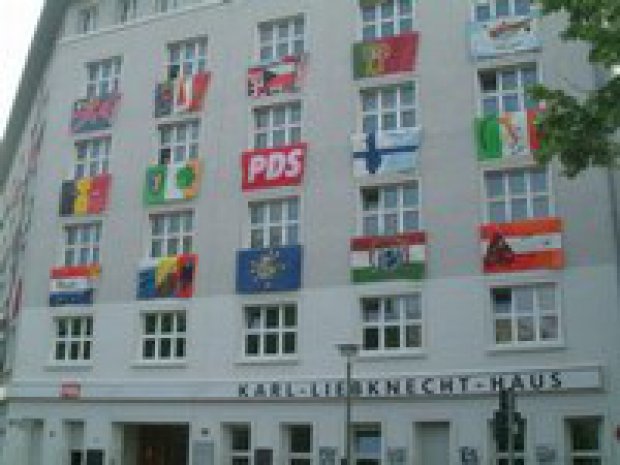
The EL Executive Board (ExB) held its fourth session in Berlin according to the work schedule. During the two-day meeting the EL ExBoard members, representatives of observer parties as well as guests participated in the traditional commemoration of Rosa Luxemburg and Karl Liebknecht, taking place each year at the second Sunday of the year to memorize the murder of these two revolutionaries in January 1919. For the first time this was a topic of the European Left, decided upon at the EL Founding Congress. <//span>
EL Chairman Fausto Bertinotti and Helmut Scholz (PDS) chaired the meeting.
The ExB co-opted the newly introduced comrades Maite Mola, Communist Party of Spain, and Peter Székely, Hungarian Workers Party, who will work as a member of the ExBoard instead of Comrade Vajnai.
Present at the meeting were EL treasurer Pedro Marset (I.U. – Spain) and elected Board members – G. Hopfgartner (Austrian CP), M. Hornychova and J. Hudecek (SDS - Czech Republic), S. Kingsepp and E. Ehala (ELP - Estonia), Ch. Mendelsohn and J.-F. Gau (PCF), K. Schubert and H. Scholz (PDS -Germany), N. Theodorakopoulou and St. Pappas (Synaspismos - Greece), G. Mascia and G. Migliore (PRC – Italy), P. Szekely (Workers' Party, Hungary), Maite Mola and José Luiz Nunez (CP of Spain), Antoni Barbarà (EUiA – Catalonia, Spain), Willi Meyer (I.U., Spain) Brigitte Berthouzoz and Jozef Zisyadis (Labour Party of Switzerland).
The observer parties AKEL (Cyprus) was represented by Chrysanthos Zannettos, the CP of Bohemia and Moravia (Czech Republic) was represented by Vaclav Exner and Hassan Charfo, the Left Bloc from Portugal by Miguel Portas and Carmen Hilário, the Communist Party of Slovakia by Karol Ondrias.
ExB-Members Waltraud Fritz-Klackl (ACP), Gianluca della Valle (RC San Marino), Annamaria Rotaru and Constantin Cretu (SAP) as well as Laszlone Szabo (HWP) asked to be excused.
The member party Socialist Alliance Party (Romania) was represented by its Vice chair Cornel Florin Balaure. The Party of Italian Communists (PdCI) and The Left (Luxemburg), both observer parties, as well as the NGLA-representatives had informed not being able to participate.
Invited guests included the Red-Green Alliance (Enhedslisten) of Denmark representative Thomas Clausen, the German Communist Party representatives Heinz Stehr, chairman, and Leo Mayer, Board member, Polish Socialist Party Vice Chair Jerzy Stefanski, the Turkish Freedom and Solidarity Party Vice Chair Haydar Ilker, PDS National Executive Board member and speaker on Foreign affairs Wolfgang Gehrcke, the activists Paola Giaculli (Prc), Josè Cordon (FCP), Dominic Heilig (o.b. EL Office) and staff.
Main results, decisions and agreements:
1. The Board discussed and exchanged views on current developments within the EU and the home countries of member parties. All participants of the meeting remembered the victims of the earthquake and tsunami in South and South-East Asia with a minute of silence. Special attention was given to the beginning process of ratification of the EU treaty for a constitution of Europe. The European Left is challenged to combine in its campaign for a “NO” convincing arguments for referenda with concrete alternative proposals for a different constitution of Europe. The ExB took notice of some examples for public material (leaflets, flyers etc.,) produced already in Spain and being in preparation in France.
A political statement on the presidential elections in Palestine (which took place the same day) and EL positions on the situation in the whole Middle East region were discussed and adopted, the ongoing solidarity with the Palestinian people once more stressed.
Discussed was the situation in South and South-East Asia after the Tsunami-disaster; a broader exchange of views concerning possible ways for supporting immediate international aid to the people living in the poorest affected regions as well as creating a long- and mid-term strategy of future disaster prevention. The EL Executive Board adopted a joint statement (). On initiative of Synaspismos the Executive Board protested against the extradition of Kurdish activist Sinan Bozkurt to Germany.
2. The Board received reports of ExB members responsible for working groups and took the necessary decisions:
(a) Report on the EL initiative for an alternative “Pact of full employment and social security” to break the all-pervading power of the EU stability pact. This process has to be more closely linked to the social struggles going on in the EU countries. It must be developed within the time frame of the ESF and trade union debates on social and economic affairs, on resistance to neo-liberal models.
The Board confirmed the initiative to present first theses on an alternative stability pact paper in the discussions with social movements during the alternative Social Summit (March 18-19, 2005 in Brussels). A possible occasion could be the GUE/NGL hearing on the „Bolkestein“ directive (on services) on March 18, 2005 in Brussels. The EL joins the international „Anti-Bolkestein-initiative“ webpage and actively collects signatures within their membership as well as in the public ( www.stopbolkestein.org )
The draft theses should be sent out to all ExB Members till March 3 for further comments and proposals.
R.: J. -F. Gau and N. Theodorakopoulou (for the two working groups)
The activities and work of the EL ExB working group “alternative stability pact” will be included in future in the general work of the newly formed horizontal structured EL working group on economic policies (Paris, 2004). All ExB members are requested to inform their parties on that decision and to establish links to corresponding structures in their parties working on left alternatives to neo-liberal economic policies. The EL will stimulate new forms of cooperation and communication tools (for example mailing-lists) to advance discussions between activists and members on these issues.
R.: all ExB members
Members / Contacts of the working group – confirmed until now - are:
French CP: A. Obadia ( aobadia@pcf.fr ) and as EL ExB contact J.-F. Gau ( jfgau@pcf.fr )
Romanian SAP: C. Cretu ( c.cretu@xnet.ro ) as EL ExB contact to SAP
PDS: J. Dellheim ( Judith.Dellheim@web.de ) , B. Schneider ( gzimmer-assistant@europarl.eu.int ), H. Markov ( hmarkov@europarl.eu.int )
(b) Report of the working group on EL web presentation: On the basis of documents sent out earlier (workflow, sitemap) and the presentation of the EL website and the Content Management capabilities of Plone by “minuskel screen partner GmbH “ the ExB has been informed that the final technical construction of the website is ready from February 25. Therefore the editorial group has to be built up till that time. All parties (Member parties as well as Observer Parties if interested) are urgently requested to nominate their representatives for this group. (Decision of the Paris meeting - each party should be represented by at least one member in the editorial group, being the contact to the web-presence of each party).It is confirmed that English is the working / “guidance” language. All parties themselves are responsible for translating the common documents, the contents of the webpage into the mother tongue.
(c) W. Gehrcke gave a short report on behalf of the working group “Preparation of the 60 th anniversary of victory over Hitler-fascism and end of World War II”. He suggested combining several activities – common as well as individual actions towards antifascists and activists of the liberation struggle. The Left should join all activities to resist any attempt of revising history and the broad resistance struggle within the European societies. That is even more important in view of the new wave of history revisionism and the growth of right-wing extremism in almost all European countries, in Central and Eastern Europe in particular.
Agreement was reached on the broadest possible participation of EL representatives in decentralised meetings and public activities on that occasion. The already scheduled two EL conferences / meetings (Potsdam, Prague) should be directly connected with the task to commemorate the 60 th a anniversary: first, the EL meeting of left parliamentarians taking place on 18-20 March in Potsdam and Berlin, secondly the International Conference ”Socialism in the XXIst century and international security policy” hosted by the CPBM on 23-24 April in Prague. (The CPBM confirmed at request to convene that conference as a joint initiative by CPBM, GUE/NGL and EL).
During the discussion special attention was drawn to difficult discussions about the historical relationship of liberation/occupation in Estonia and other Baltic countries. A lot of aggressive attacks to equate German fascism with Soviet rule in the Baltic’s are carried out by the conservative forces as well as the media in that direction. The Estonian Left Party representatives asked for stronger support from other EL parties to spread information about these attacks and the “official political behaviour” of their government in all European countries. It was suggested to make this aspect a topic of the political fight all over Europe against the revision of history.
Representatives of all EL parties are requested to take part in the meetings with resistance fighters and to stress that the EL considers the liberation from German Hitler-fascism as the real birth of the new Europe.
(d) N. Theodorakopoulou gave a report of the ExB working group co-operation with social movements on the preparations of the 4 th World Social Forum in Porto Allegre. The EL will be presented by a considerable number of EL parties’ activists in Brazil. They are members of national delegations and will participate in the WSF workshops as well as in political debates organised by themselves, for example in the Parliamentarians’ meeting as well as in various workshops of the political foundations etc.
Information was given about further preparatory work for the 4 th ESF 2006 in Greece; the first meeting of the international preparatory committee for it is to be held in Athens, February 26-27, 2005.
Christine Mendelsohn called for a permanent co-operation of the EL with the social movements. The EL has to emphasize the role of the European metropoles as well as its own relationship to the Mediterranean region (MrSF, Barcelona 2005). Maite Mola focussed on the women’s forum. It is very important to include this item in the ESF preparatory meeting in February.
The coordinators of the working group Natasa Theodorakopoulou and Christine Mendelsohn (for the MrSF in particular) are requested to inform about the results of the WSF in Porto Alegre, the preparations of the Brussels Alternative summit /European Action day and the other meetings scheduled for 2005/2006) at the ExBoard meeting on 12-13 March in Brussels.
3. The ExB received information by G. Migliore (PRC) about the ongoing work of the EL working group ‘EU Constitutional Treaty’ (ECT). He gave a survey on the state of ratification of the EU Treaty for a Constitution for Europe in the various EU member states and the position of the different political forces towards the ratification process. He discussed the different – positive and negative – aspects of the Constitution treaty and the perspectives of ratification in the EU member states. He explained the opportunities for campaigning the NO to the EU-treaty for almost all parties. He stressed that the EL has to focus its campaigning capabilities on those countries, where referenda will take place and real chances exist for getting a majority against the EU Constitutional treaty. Common papers / information material - i.e. leaflets, posters, booklets and other material for use in the campaign have to be worked out and produced.
During the debate it was stressed that the ECT is considered to be a step back in questions of gender equality and that this dimension of inequality should be part of the campaign, in particular the effects of privatisation on the situation of women (CP of Spain). For the PCF Jean-François Gau reported about the political debate on the EU Constitutional treaty in France. The EL should focus on the link between the (neo-liberal) contents of the constitution and the present suffering of the people. But he also stressed that it is decisive to stress the “No to the Constitution”-campaign in the name of Europe, not in a nationalist sense, as the political Right is doing. He pledged for working out a common EL leaflet as soon as possible. It should be presented on the same day in all countries. He suggested to create an information/support network which should cooperate against the constitution. Thirdly, numerous events and meetings should be organized by the EL parties to popularize the campaign via joint presentations.
In the debate Helmut Scholz stressed the importance of reflecting on the time table of ratification procedures in some countries; i.e. the results of the referendum in Spain will be used for the acceleration of the ratification procedures in Germany at the parliamentarian level in a very short period of time and that its results will have an direct impact on the campaign in France. So the political Left has to deal with these developments in a political sense. It means: a common leaflet is not enough, but the working group should accelerate the work in order formulate concrete alternative positions of the EL for own proposals concerning the European Constitution. Concentration should be given to economic, social and peace alternatives.
Wolfgang Gehrcke stressed the importance of a political agreement of the EL in the constitutional question for its identity.
For Synaspismos Stelios Pappas informed on the situation in Greece. He called for formulating an alternative policy on the EU Constitution very quickly.
Summarizing the debate it was agreed, that the working group ‘EU constitution’, should continue its work. The working group is required to concentrate on the following questions:
- to work out a timetable of the public campaign for European referenda;
- to take part in the Barcelona meeting of the Spanish EL parties;
- to produce a common leaflet in the proposed sense;
- members of the EP representing the EL member parties take an active part in the debate in the EP.
- to propose texts on the main problems of an alternative EL text for a socially just, peaceful, democratic Europe as an alternative to the existing EU constitutional treaty and other burning issues of further EU development (i. e. positive / negative parts of the constitution, alternatives; the subject of further political developments in Europe, the stability pact, the services directive – the main issues of European policy despite the further fate of the EU Constitutional treaty etc.);
- to request the French CP to initiate concrete proposals for common actions of the EL in the campaign for a No to the EU Constitutional Treaty and to include all this into the campaigning schedule.
- R.: G. Migliore
- Preparation of the 1 st EL Congress, October 8-9, 2004 in Spain
EL Chairman Fausto Bertinotti used that topic to explain first ideas and some expectations in connection with the 1 st Congress of the EL.
He took the opportunity to invite all EL ExB Members to the PRC congress in Venice (March 3-6).
Concerning some aspects of the EL 1 st Congress he stressed in particular:
- The congress should not be an imitation of the congresses of the national parties. It should be a political significant event: first, it should be built in relationship to European social movements; secondly, it should address the most active layers of the society; thirdly, it should become a mobilizing moment for the EL itself; shortly: it has to reflect the European understanding of the political cooperation of Left parties within the EL.
- The 1 st congress should also present an “EL identity document”, which should not be the answer to the question who we are, but what we want, how the Europe we want shall be.
- In a second part of the congress the CoCh, the EL ExB and the delegates have to make an evaluation of the work of the EL from the point of view of organizational and structural experience. The aim should be to enhance the consolidation of the party.
- The Congress should also discuss and decide in the interest of future political capabilities of the EL whether majority decisions in the EL are possible.
- It was decided that the Congress preparatory group should be constituted within the next two weeks. The group is to consist of one member from every member party, either being ExB member or representing the existing working groups or representing other member party structures. The gender quotation should be a guideline, but not a dogma for the construction of the preparatory group.
5. On the EL political agenda and the 2005 work schedule
- Summarizing various proposals, a revised draft work-schedule for 2005 (as PDF) was principally adopted. Its main points are:
- 1st EL Congress, Barcelona, October 8-9, 2005, including a women assembly on the eve of EL congress;
- various political activities around the 60 th anniversary of liberation from Hitler fascism and end of World War II, May 8 and 9, 2005;
- EL support for various political activities of EL parties in their campaigning on the EU Constitutional Treaty in the referenda in the EU countries
- the ParlaCon ’05 - meeting of deputies of different parliamentarian levels (municipal, regional, national, European) of EL member parties, Potsdam, March 18-20, 2005;
- participation in the 5 th WSF, Porto Alegre January 2005.
- Participation in the European Social Action Day, Brussels 18-19 March, 2005.
6. At the request of the Council of Chairpersons the EL Executive Board had to finally decide on the applications of various European left wing parties for observership resp. membership forwarded to the Party of the European Left. It was agreed to decide about those applications sent to the EL until the meeting of the CoCh (October 25, 2004) or renewed until November 30, 2004 – the date of publication of the results of the EL ExBoard meeting in Paris (November 2004).
The ExB agreed to grant observer status to the
- Red-Green Alliance (Enhedslisten), Danmark
- German Communist Party (DKP), Germany
- Freedom and Solidarity Party (ODP), Turkey .
Representatives of the three parties explained the reasons for their applications and informed about current developments and positions of their parties.
Miguel Portas, Left Bloc, Portugal, informed the EL ExB about a unanimous decision of the Party Board to change the LB’s status from observership to membership. This decision has to be confirmed by the LB's next party congress (May, 2005) before becoming valid.
The application of the Communist Party of Finland for observership status (letter dated 21.12.04) has been noted; it was agreed to forward it to the Council of Chairpersons according to the EL Statutes for the further procedure and also to enable member parties to discuss the application.
Concerning the letter of the CPBM proposing a meeting of EL parties and other left wing, mainly communist parties the ExB decided to stick principally to the regulations and principles of the EL Statutes. It was stressed that there is no need to change the procedures laid down in these joint decisions at the EL Founding Congress.
At the request of the CPBM (letter of Vaclav Exner and Hassan Charfo) the EL ExBoard discussed various aspects of the CPBM relationship to the EL, including proposals of general understanding of the EL as well as concrete passages of the EL Statutes (see the underlined phrases:
Therefore we refer to the values and traditions of the socialist, communist and labour movement, of feminism, the feminist movement and gender equality, of the environmental movement and sustainable development, of peace and international solidarity, of human rights, humanism and antifascism, of progressive and liberal thinking, both nationally and internationally. We work together in the tradition of the struggles against capitalist exploitation, ecological destruction, political oppression and criminal wars, against fascism and dictatorship, in resistance to patriarchal domination and discrimination against “others”.
We defend this legacy of our movement which inspired and contributed to securing the social certainties of millions of people. We keep the memory of these struggles alive including the sacrifices and the sufferings in the course of these struggles. We do this in unreserved disputation with undemocratic, Stalinist practices and crimes, which were in absolute contradiction to socialist and communist ideals .
The political and economic developments in the capitalist societies at the beginning of the 21st century create the necessity and the possibility for parties of the Left, for democratic movements and alternative social forces, when working out and realising social alternatives not only to take into account all aspects of globalisation and internationalisation. Europe as a new space for the integration of more and more countries in East and West, in North and South is both an opportunity and a challenge to regain the political initiative for Left forces. We want and have to most closely combine our work on this political level with the social activities of members and sympathizers of the party organisations within the communities, regions and nation states.
We are doing it in sharp rejection of and developing an alternative to capitalism and to the financial hegemonic groups with its worldwide attempts of pushing through neo-liberal policies into the daily life of the peoples by the so-called political and economic elites.
In a frank and principal debate the El Ex Board unanimously stressed that the agreed formula in the Statutes on the term of “Stalinism” is “non-negotiable.” This understanding includes the need and the will of the Board to review permanently the experience and results of the common political and organizational work, to seek further improvement of the political practice and to react on developments in the societies.
The Board stressed at the end of the debate that it regards this discussion as finished. The positions are clear and open since the founding congress; the debate on that issue is part of the founding principles of the EL.
8. Individual membership
The ExBoard finally agreed to the paper proposed by Jiri Hudecek and Miroslava Hornychova some time ago. The Board stressed that all El parties should take more efforts to open concrete ways for interested sympathizers of the EL, its logic and ideas, to join the party.
After the experimental period of 2 years the EL ExB has to analyze the various experience, forms and practical steps of EL parties to attract individual members, the expectations of individual members and their reflections on the EL, on their chances to take part in the development of the EL. These analyses are to be presented to an EL Congress for further discussion of that aspect of EL development.
9. Working languages
At a request of the French CP and the Spanish member parties the ExBoard discussed the general issue of using other languages besides English as EL working tools.
During the debate on that issue the common point of view was stressed that the EL has to protect the cultural and language diversity as an important value and part of the European cultural heritage. On the other hand the concrete financial and material conditions for the internal organization of EL work means to reduce the costs to a reasonable minimum. Therefore, cooperation in the EL needs a broadest possible support from the EL parties to guarantee equal opportunities for all parties to cooperate within the EL.
During the debate it was stressed that the language problem affects all structures and levels of the EL as well as the public presentation of the political Left both at the European level and inside the parties. To develop cooperation between the parties and the parties’ membership a maximum of readiness and efforts is needed to overcome the language barrier, to translate common texts etc. and to reflect on the common difficulties in that direction. Therefore it should be possible not to make the use of languages a political and principal question but to find flexible forms answering the concrete conditions and opportunities. This question should be reconsidered from time to time according to practical experience the EL will collect in its various new forms of cooperation.
During the meeting is became obvious that EL structures with members or representatives not being able to use one working language need a multilingual procedure of work. That means the use of simultaneous translation. Therefore the EL has to include in its work an own budget title for translation costs.
It was agreed to try to concentrate for the next meetings of the Board and of other EL working structures on the use of English or English and French as working languages. T he question of translation should be handled flexibly depending on the place of the meeting and the possibilities of the members taking part.
This temporary compromise concerns only he way of organizing internal meetings. For all other activities (public conferences etc. ) a concrete proposal has to be presented to the Board as part of the financial plan of those activities/ proposals.
It was also agreed that English is to be kept as the only working language for the written communication and the exchange of texts and papers.
10. Treasurer Pedro Marset gave a report on the financial and structural situation of the EL . He informed about the budget 2004 (main expenditures and income-situation) and the planning for the EL budget 2005.
11. As discussed and decided by the ExB during the Brussels meeting in September 2004, the EL from November 20 has a provisional office in Brussels at REGUS Brussels Schuman [address: Rond Point Schuman 6, B-1040 Brussels] for a maximum term of 3 months. A permanent office solution has to be prepared and decided as soon as possible.
Other items
- The EL ExB took note of a report of Dr Dietmar Wittich concerning the Rosa Luxemburg Foundation (rls) backed study ”Synopsis of the socials milieus of selected European left Parties”, and had a discussion on it. The rls will continue in spring 2005 (March / April) its seminar on “Left wing party policy and practice”. Interested people of EL parties, in particular sociologists should be informed through all ExB Members and could be invited by the rls, if interested.
- The distributed questionnaire concerning interaction of left wing parties in Europe, formulated by Martin Schirdewan, is requested to be sent back to him directly for further scientific work on this subject as soon as possible.
Original Language / EN