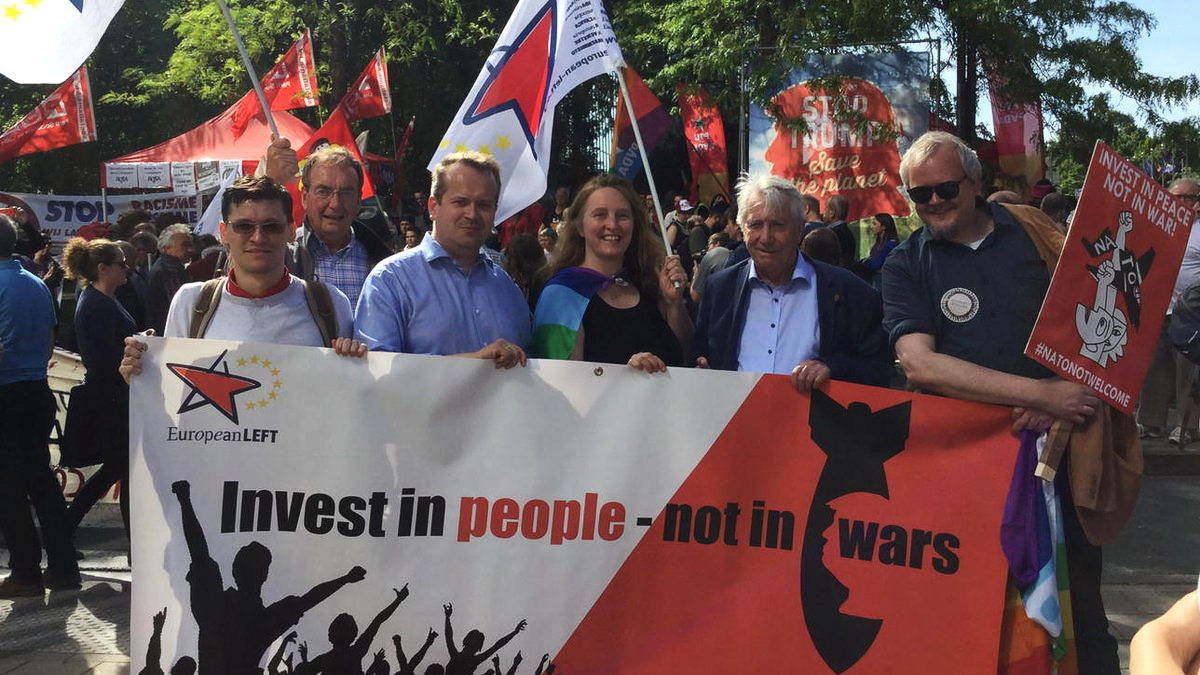
What’s the situation of the left in your country? Dei Lenk was founded in 1999. The party is a pool of all forces left of the social democrats who resist neoliberalism. In its successful times Dei Lenk managed to win seats in the Luxemburgian parliament. But then there was a secession of comrades of the KPL, the communist party, who felt underrepresented. This led to an election defeat so that we are currently not represented in the parliament.
Besides, Dei Lenk is not a party in the usual sense. It always wanted to be a movement, that is stay in contact with other movements, focus on extraparliamentary activities. And despite the election defeat we still are a moving power. We are the only opposition in the country concerning lots of questions because there isn’t really any opposition left in the parliament.
As regards its movement character, would you compare Dei Lenk with Rifondazione Comunista in Italy and with the direction this party has been taking in the recent past?
Well, maybe I would. However, we are less structured. In a way we‘ve got a structure of grassroots democracy like the Greens in their early years including all those difficulties associated with that. We don’t have a chairman, we’ve got the principle of rotation. Rifondazione doesn’t have that as far as I know.
Are rotating offices also a model which left Luxemburgians would like to see in the EL?
This also implies disadvantages. It only works out if the movement is very vivid. And then I wouldn’t want to prescribe anything to the EL. Different traditions and organisational structures should exist side by side.
Which questions of European interest are momentarily being discussed inside Dei Lenk?
We are aware that through the European Left we have the opportunity to participate in European debates which matter for us, such as the debate on the European constitution, the debates on the Services and Postal Directives, the whole issue of neoliberalism. We are the party that bluntly asks these questions and doesn’t define itself within the Lisbon Strategy. We also put a lot of emphasis on the fight against war and the surveillance state.
What expectations do you have regarding the EL Congress from 23 to 25 November in Prague?
I expect the Congress to stir a lively discussion. I think it’s important for the EL to be more than just an umbrella organisation and that horizontal connections exist between its parties, that means contacts and dialogues. Then the Congress must set the frame for the next years. Since the foundation of the EL in 2004 we have faced the public under several expectations. The Congress will have to estimate whether we have met these expectations and whether new questions have evolved.
We will also have to consider the experience of other countries, the success of the left in Germany, the defeat of the left in France or the issue of government participation.
From your perspective, what has the EL achieved over the last years? What remains to be done in the future?
The EL has achieved that it works. It has created links between people from 16 or 17 diverse parties who talk openly to each other without difficulties and without using party lingo. In the past my experiences with international contacts were sometimes different.
Moreover, working at specific topics is important. The European Left has established working groups, some of which also operated, even though very slowly and inefficiently. That’s because of the language problem. When you got working groups you also have to discuss things very precisely. And it’s also due to structural impediments. The connection on the median level is decisive. It can also be initiated by seminars, events etc. that take place in the single countries.
After all, the question is how much the EL has entered the minds of party members and of the public. In this respect we haven’t advanced very much yet. I can say that much at least for Luxemburg. This situation can only change if we do things together, as for example campaigns, and if we put out our feelers beyond the narrow scope of our party. The EL is a useful tool that still needs development.
Original Language / EN