Nachrichten / 16 Jun 2016
Gehe zu Nachrichten“Open political platforms” and “electoral fronts” to transform the society from left governments
The Party of the European Left (EL) argues that the analysis of the socio-political and economic situation in which we live in Europe have to be necessarily accompanied by alternative left policies to be able to re-found Europe on another supportive economic model.
The Bulgarian capital was chosen by the EL to debate during the whole day of May 28th on these alternative politics, necessary to break with the neoliberal model of a European Union that is in deep crisis. In this debate took part representatives of more than 10 parties of the European Left, along with representative voices from the world of culture, social movements and trade unions.
Margarita Mileva, vice-president of the EL and chairperson of Bulgarian Left inaugurated this international conference. She did it with a debate dedicated to the challenges and the alternatives of the left in Europe, saying that “we have to explain the democratic socialism” at a time in which the left is very discredited after the collapse of socialism and where there are parties which are declared on the left but occupy spaces on the right.
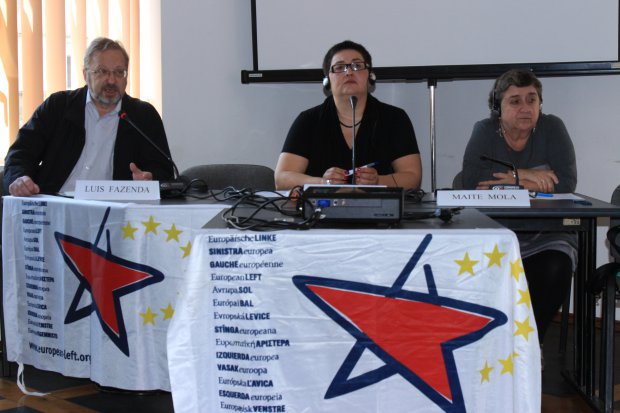
Spain, on the eve of elections of June 26, is in the crosshairs of a European political and social left that awaits with great interest and hope that the forthcoming elections may allow the formation of a left-wing Government, so "we would be more countries in the European Union fighting for another regional model (…) as this European Union of treaties of Maastricht passing through Lisbon, does not serve to us" expressed Maite Mola, vice president of the EL as well as part of the direction of Izquierda Unida and PCE.
She explained to the public how and why in Spain an electoral Front had been constituted between forces like Izquierda Unida, Podemos and the ecologists Equo, in addition to the specific situations in some regions. "In a country with 23% of the population under the poverty line, we cannot afford to get a poor percentage. We aspire to govern, to end with the austerity and corruption and demonstrate that other policies are possible. And do it in a mestizo government, but working together on core issues on the basis of the slogan of the Marches of Dignity: bread, roof and work". She added that although the goal is to arrive to the socialism and in its case to the communism, on the way it is necessary to solve the needs of the people.
Portugal now lives the experience of a left-wing Government. For the last six months, the Socialist Party governs in minority with the support of the Bloco de Esquerda and the Portuguese Communist Party in Parliament, which did not want to be part of the Government but joined to block to prevent a government led by the social democrats.
They did it on an agreement of minimums that Luis Fazenda, from Bloco de Esquerda, qualified positive for the time being, as it allows to be recovering wages, pensions, public services and social welfare that had been destroyed by the Troika and the conservative governments, “and this is the priority”. He added that privatizations have been reversed in public transportation, at the same time that they are facing the pressure from the EU to develop a labour reform similar to the Spanish or French law.
Fazenda spoke of the need for the "regroupment" on a new broad concept of the left, with a new type of parties and social alliances with feminism, environmentalism and all those meaning progress to build a new society opposite to globalism and imperialism. He called it "open political platforms" in which the parties of the new left maintain their ideological pluralism, with their different conceptions of the world, but everyone in the left. It must be a fluid and open platform with an idea more of a "front" than a party closed.
That is “a tool that allows the social blocks to support these platforms” putting the accent “in the common questions instead of doing it on the ideological questions that differentiate us”.
2
Social and unionist international fronts
From Bulgaria, Professor Todor P. Todorov, of the University of Sofia St. Kliment Ohridski, deepened on the front of the struggle and at the international level opened alternative spaces, with new policies and strategies to create a new order. This shall be done on a broader front: "It is not possible to fight if we are not together at international level, with young people, environmentalists, feminists". And there is no time to waste.
Todor P. Todorov also stressed the need to have good political speeches, "because if we silent, the chaos will speak". He explained that the people are tired of living this kind of life of insecurity. He spoke on the collapse of the neoliberal culture and stated that democracy has become a process of restoration opposed to innovation.
The Greek MEP of Syriza, Kostandinka Kuneva, defended the need of unity at trade unions level. She started speaking about the weakness of unions that have seen diminishing their power in the recent decades and have lost the confidence of the people by their inability to adapt to changes in the economy and employment.
The MEP recalled that the structure has changed drastically. Before the industry was the basis of economy but it has been moved to Asia, leaving Europe as a society of services. The values have also changed, prioritizing the competitiveness to the detriment of the solidarity and companionship.
Kuneva argued how the capitalism and the multinationals are linked and how they are coordinated to debilitate the workforce and also to impose free trade agreements as the TTIP. The only possible way to face them, she added, is by strong trade unions of base and by the unity: “"if we don't unite we will return to the nineteenth century, a world without rights. It is a question of survival."
Asli Aydin, economy columnist of the of the Turkish newspaper BirGün, and member of the leadership of ODP (Freedom and Solidarity Party) made an analysis of the process of neoliberal capitalism and the resistance movements worldwide during the last three decades, starting with the mobilizations of the 90s against the IMF and austerity, the revolution chapatista and the international language of commander Marcos, the processes of the Bolivarian revolution in Latin America, the examples of Ecuador, Bolivia...., mobilizations against the global capitalism, as well as against the invasion of Iraq, etc.
She finished the analysis with the anti-government protests in the Gezi Park in Istanbul, of three years ago, the criminalization of the protests by the Erdogan government, in power without opposition during the last 11 years, and a new generation of protests in which movements are brought together by eliminating their ideological differences “to fight joined from the universities and all the fronts to the Islamic fascist regime”.
3
From local to global struggles. Some Bulgarian experiences
Some of the alternatives discussed in the international conference came from concrete experiences running in Bulgaria. One of them was the proposal of a progressive fiscal policy, with less indirect taxes and more direct ones. Today in Bulgaria the indirect tax are around 55% while the direct lie between 10 and 20%. The economist and journalist Dimitar Sabev, coordinator of the group "Together for a fiscal justice" argued how Bulgaria is the European country leader in inequality since the implementation of the tax level gravel all income with 10%. After having studied the taxation rates and the level of happiness of the people in 150 countries, he arrived to the conclusion that inequality is the cause of unhappiness.
He gave an example: in a neighbourhood of a city where average receives 200 euros, one who gains 300 feels happier than the rest. In another quarter of the same city where the average gains 600 euros, he one who earns 700 feels happier. And at the end the one who earns 300 in the first district will feel happier than the other one who earns 600 on the other neighbourhood.
He also explained that people live happier in those countries in which they pay more taxes, while in the countries that collect less money there is a greater level of poverty and inequality. The first one would be what he called “the beneficial spiral” that is generated by the increase of the income from the taxes. The second would be the "maleficent spiral" where low income means lower investment in education health, etc...
The main wave of privatization has begun in Thatcher and Reagan period and then the IMF and the World Bank implemented on the basis of the economic difficulties imposing their conditions.
And privatization came to the water. A European Citizens Initiative submitted 1.9 million signatures to the European Commission claiming that water is a right, not a business, but the European institutions have ignored it, explained Vanya Grigorova, President of the Association "Joint and several Bulgaria".
She explained that before giving the concession, 30% water was lost, but when it was privatized the loss doubled to reach 60% by lack of maintenance, but at the same time they paid advisory fees of 6,800 euros a week, money which was accounted as investments in the network of Waters of Sofia.
The worst, Grigorova criticized, is that workers felt that it would be better when privatised: "We remain confident in the privatizations and concessions because the media repeated the mantras of the World Bank", although the reality, she added, is that the price has increased at the same time that the water quality and the working conditions of the workers have worsened. The Bulgarian activist also reported on the struggle that is being conducted against the TTIP and CETA from "Solidarity Bulgaria".
The journalist of the national public radio of Bulgaria, Peter Volgin, intervened on the spread of neoliberalism in the media: "the public media should be the only alternative to the dogmas imposed but it has become a place where neo-liberalism is at ease because it defends its dogmas from this platform as well." He recounted that is like a brainwashing which imposes that the State is terrible, slows everything it touches and that if you want to prosper you need to strength the market. He illustrated that they know well that if they want to govern the minds they have to work with journalists in the media and in the universities.
Original Language / EN