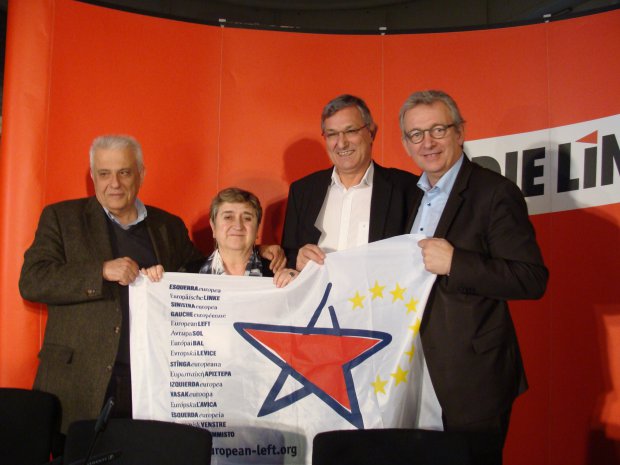
Ce mardi 17 février 2015, le Parti de la gauche européenne, accueilli par Bernd Riexinger, Co-Président de Die Linke, a organisé une Conférence de presse à Berlin en présence de Pierre Laurent, Président du PGE, Maite Mola, Vice Présidente du PGE (Espagne) et de Theodoros Paraskevopoulos, coordinateur du groupe Parlementaire de Syriza (Grèce). Les dirigeants de la gauche européenne ont réagi à l'actualité, notamment aux résultats de l'Eurogroup, et avancé leurs propositions communes pour sortir de la crise.
Pour le PGE, les gouvernements en Europe doivent accepter l'accord-pont, proposé par le 1er ministre grec et son ministre des finances. Pour Pierre Laurent : « c'est l'absence d'un accord avec le gouvernement grec qui pourrait coûter très cher à toute l'Europe.». Pour le Président du PGE qui dénonce le chantage de l'Eurogroup, un accord entre le gouvernement de Syriza et ses partenaires européens est « légitime et nécessaire ». « C'est une question de démocratie, les grecs ont refusé l'austérité, il n'y a donc aucune raison de les obliger à appliquer le programme négocié par Samaras » dit-il.
Theodoros Paraskevopoulos a réaffirmé la détermination du gouvernement Tsipras « Les mesures humanitaires ne sont pas négociables ». Maité Mola a abondé dans ce sens en évoquant la situation sociale extrêmement préoccupante en Espagne. Et Bernd Riexinger d'ajouter « Syriza a ouvert une porte pour une autre politique. D'autres veulent la refermer mais leur politique a échoué ».
Les quatre ont signé une déclaration (en bas, en anglais) proposant des solutions de sortie de crise par le développement social et écologique et par un nouveau départ démocratique en Europe.
Parti de la gauche européenne
17 février 2015
Hope for a democratic awakening in Europe
The victory of SYRIZA not only gives hope to Greece for a social way out of the crisis but opens possibilities for a democratic awakening and a fundamental change of direction of the European Union as well. The socially devastating and economically counterproductive troika policy has been sanctioned by the democratic expression of the Greek people on Sunday, January 25, 2015. The Tsipras government offers the real chance for another policy focussing on the people. First brave steps towards improving the social situation, starting to rebuild the Greek economy on behalf of the public have already been taken.
This leads to consequences for other European countries. Especially in Southern Europe - where the damaging effects of the troika policy can most strongly be felt - peoples regain dignity and fight against the unsocial austerity policy and the dismantling of democracy in the EU. Some left political forces sharing this struggle and proposing solutions to exit the crisis gain steam. In Northern Europe the conditions for the fight against neoliberalism have improved as well. In these countries poverty, unemployment and the growing gap between the poor and the rich are strongly criticised. Right now in Germany, a country most strongly putting its neoliberal stamp on European policy, precarity and the low wage sector are being extended and income and asset differences have grown considerably.
We show solidarity with the fight of the Greek people and support the new Greek government. The struggle of the Greek people against austerity and for regaining dignity and self-determination is our struggle as well. Starting from Greek elections there could be a new departure bolstering left forces in Europe and ringing in an urgently needed change of direction of European policy. But this is not happening by itself, resistance in Europe must regroup. We decidedly turn against all attempts to undermine the democratic decision of the Greek people or even to blackmail the Tsipras government. The Greek government demand fair negotiations and time to propose a new deal with the EU. This is a fair, reasonable and sustainable offer. We rather demand the cooperation of the European institutions and especially the European Central Bank.
We support the claims of Syriza because those are the claims of the peoples and all left forces in Europe. Particularly we demand:
- A European debt conference modelled after the London conference of 1953 with the aim of solving the debt problem not only for Greece, for the all Europe.
- The power of the banks needs to be restricted; states must be relieved from being susceptible to blackmail by the financial markets. The ECB has to act as a "lender of last resort" for the member states and to deal direct loans with low interest rates.
- Instead of focussing on austerity the benchmark for a European economic policy must be a sustainable, social-ecological economic development, employment, and social security.
- A fair tax system, taxing financial transactions, and increased taxation of high incomes and assets as well as a deep cooperation at European level to fight against tax evasion.
- Public investment programmes for bolstering the public infrastructure and services of general interest, and an ecologically and socially sustainable development.
- A programme combatting mass and particularly youth unemployment.
We fight for an end of the troika policy in Europe and for the development of a social, democratic, and peaceful Europe. We will actively go on with it. If a social alternative and democratic departure fail, a further reinforcement of an extreme right and neo-Nazi’s in Europe is impending. We stand for a policy not only representing an alternative to austerity but also involving a clear refusal of the nationalist, xenophobic, and racist policy of the political right. The basis of our policy is solidarity.
Such a policy change can only come about if we build a broad platform of left parties, trade unions, and social movements. During the next weeks we invite for talks about this. We call on all left parties, social movements, and progressive forces to support the new Greek way and thus to fight for an end of the unsocial cutting policy in Europe and for a solidary, social, democratic, and peaceful Europe.
Signatories
Heinz Bierbaum, Co-Chair of Die Linke (Germany)
Jose Luis Centellas, General Secretary of Spanish Communist Party (Spain)
Paolo Ferrero, National secretary of Partito della Rifondazione Comunista (Italy)
Vojtech Filip, President of the Communist Party of Bohemia Moravia (CPBM) (Czech Republic)
Abdullah Korkmazhan, General Secretary of United Cyprus Party (BKP) (Cyprus)
Cayo Lara, General coordinador of Izquierda Unida (Spain)
Pierre Laurent, President of the European left, National Secretary of French Communist Party (France)
Marisa Matias, Vice-President of European Left, MEP, Bloco de Esquerda (Portugal)
Joan Josep Nuet, General Secretary of the Communist Party of Catalonia (Spain)
Theodoros Paraskevopoulo, Coordinator of the Parliamentary Group of SYRIZA (Greece)
Gavriel Pinson, President of Swiss Labour Party (Switzerland)
Bilge Seçkin Çetinkaya, Co-chair of Freedom and Solidarity Party (Turkey)
Attila Vajnai, General Secretary of Workers' Party (Hungary)
Nikolaj Villumsen, Member of Parliament and Europe Responsable of Red-Green Alliance(Denmark)
Original Language / FR