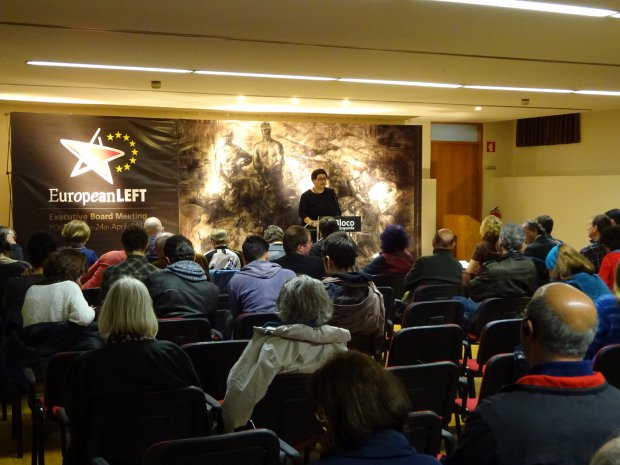
Bloco de Esquerda hosted the EL Executive Board in Porto to celebrate a friendly political evening where representatives of parties from different countries have been shown to the Portuguese public "the geographical and ideological amplitude of this European party which goes beyond the limits of the European Union" explained Renato Soeiro, who coordinated the presentation.
The speakers were exposing, one by one, the main issues being discussed in their respective countries and the focus of each party’s struggles.
Anne Sabourin, French Communist Party, explained the labor reform Hollande tries to impose and the strong response of the people with general strikes which gathered in the streets over a million citizens on April 1st, ended with the beginning of Nuit debout mouvement, which has opened "the return of social issues and the re-appropriation of the politics by the peoples".
Len Arthur, British Left Unit, also showed a window open to hope defined as "extraordinary climate where the class struggle begins to re-appear" through elements such as the doctors' strike, the election of Jeremy Corbyn in the Labor Party and the debates around the referendum on the Brexit.
The vice president of the EL Maite Mola, Communist Party of Spain and United Left, has spoken of the predictable ( definitive now) elections in Spain on June 26th, and the need for the left to present a common front, because “in the case United Left, Podemos and other forces of the left were together they could become the second political force in Spain”.
Maite Mola stressed the need to form alliances also in Europe. On the basis of the fact that "we are different", however she underlined the need to look over these differences to be able "to work and fight together to build a common project". Together as capitalism, which is globalized and well organized and is demonstrating with its project to change Governments as is doing with Brazil and Venezuela, she added.
This need to work together has been reiterated in all interventions, from north to south and from east to west. "We must fight in our countries, but without a union we cannot do anything" pointed out Attila Vajnai, Workers Party of Hungary 2006, speaking of the poverty that is killing people in his country, of the increase of the social breach and of anti-communism, racism and fascism.
Regarding anti-communism, Inna Shupac, Communist Party of the Republic of Moldova, has spoken, too. As well as Margarita Mileva, Bulgarian Left, who added the need for solidarity.
On behalf of the Party of the Communist Refoundation, the Italian Fabio Amato intervened by claiming that not only it is necessary to bring together the left but also to restore the confidence of the mistrustful people because “we promised that things were going to change and have not changed". Anne Sabourin specified this unity in the idea of “open a new political space assembling the organized left to construct a common project”.
Murray Smith, Dei Lenk of Luxembourg, intervened on the impunity with which the financial sector operates in his country and the scandalous tax exemption for large corporations. Jussi Saramo shares the difficulties to deal with austerity policies, and he also illustrated the great campaign in its country against the TTIP, the transatlantic agreement between the EU and the United States.
In Germany the battle against the TTIP is also very strong, said Judith Benda, Die Linke, who reported that 90,000 people took to the streets of Hanover that day to say “NO” to the TTIP. Benda reported about the social breach and on the unemployment rate of 7 % which although does not seem very high compared with other countries, “Germany had never been so divided between rich and poor nor had known so much precarious work”.
Natasa Theodorakopoulou, Syriza, insisted on the "need to change the balance of power not only in our countries but in Europe" so that Greece would not be the only one who fights for another Europe, as Government. They do not want allow us both to prove that there is another way rather than the dominant politics, not that our thoughts may inspire other peoples”.
"This is not the Europe we want. We should strive to change it. But one or two countries are not enough to change the course of Europe, we require more" argued Walter Baier of the Academic Foundation Transform!, defined as the little sister of the Party of the European Left.
Refugees, feminism, international solidarity as well as the international brigades at the 80s anniversary, have been some of the topics in this open exhibition of multiculturalism of the 32 parties forming the EL (26 members and 6 observers). A party that keep on growing with 15 new parties applying to join.