The crisis has a female face. And it is not limited to a single country but it has been shown everywhere, and inequalities as well occur among different groups of women within the same country. Unemployment, precariousness, part-time and undeclared work contracts, are remarkably sharpened among the women population. These are some labour discrimination suffered by women in the world of work, combined with the wage gap, reconciling motherhood with work and other forms of labour, sexual exploitation in the the working conditions of migrants, social and sexual exploitation or prostitution. The most affected are the young population and the migrants, which has also the huge problems to get a decent pension.
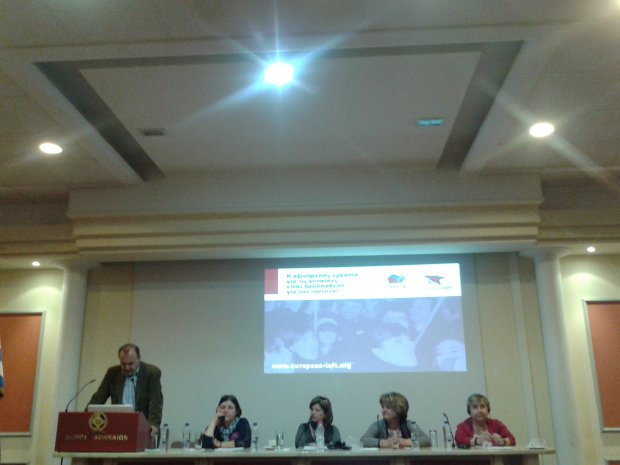
All these topics were discussed in the meeting held the 25 of April in Athens on decent work for women, as part of the Party of the European left European campaign. An analysis of the situation and causes was made, taking into account the ideology that lies behind the economic and social policies that materialize these conditions.
The conclusions stressed that patriarchy and capitalism have no borders, we must therefore analyse the issue from class dimension with the inequalities that result from it. And it was also recalled that women that are still in history as a symbol of resistance in the fight for the rights of women had a dimension of feminist and leftist. Therefore, it is up to the alternative left to collect in their programs claims and ambitions of women, as exposed by the vice President of the EL Maite Mola, who participated in the meetings. She also explained that the struggles must be done at European level, and that the States have to be an example in the protection of labour relations to preserve the gender equality at work.
In the presentation of the Conference, the General Secretariat of gender equality in the Greek Government of Syriza, explained how the measures imposed by the troika have worsened working conditions for women, and insisted that there can be no social justice without a social exit to the crisis and prior recognition of women's labour rights. It has been stressed the need of the Government control of the labour rights violations against women and end up with them.
Maternity protection was another of the issues discussed at this international meeting. It is recognized that employers consider mothers a load rather than human resources, and penalize them. The participants claimed that motherhood has a social dimension which concerns society as a whole, and is not a private matter. And also spoke of prostitution, pointing that 50 MEPs from the GUE/NGL were opposed to it in the European Parliament. It was recalled that prostitution is an issue that remains on the table in countries such as Spain where some parties raised their regularization.
Anne Sabourin, from the direction of the French Communist Party and member of the EL executive board, spoke about the same inequalities in Greece, France, Spain and other countries, and on how women are affected by capitalism in its most harsh version. She highlighted that the reduction of the public services and social protection has a major impact on the daily life of women. She explained what means the labour deregulation that involves the Macron law in France and explained the women discrimination regarding the pensions. She noted as significant fact that women are the most welcome to go to early retirement, the vast majority is doing this for fear of losing their rights, and more than half of them to take care of their grandchildren, and thus help to reconcile work and family life of their daughters, and/or for the care of other family members.
The stable and permanent employment is one of the conditions for equality. And the equality in the workplace is one of the pillars for equality in all areas. Public services are the best friends of women -and not diamonds, as the famous song claims. These were some of the key conclusions of the European campaign for decent work for women, that has made one of its early stages in Athens, and that will continue in other European countries.