News / 22 Feb 2015
Go to newsSecularism and the fight against austerity as tools against religious and political fundamentalism
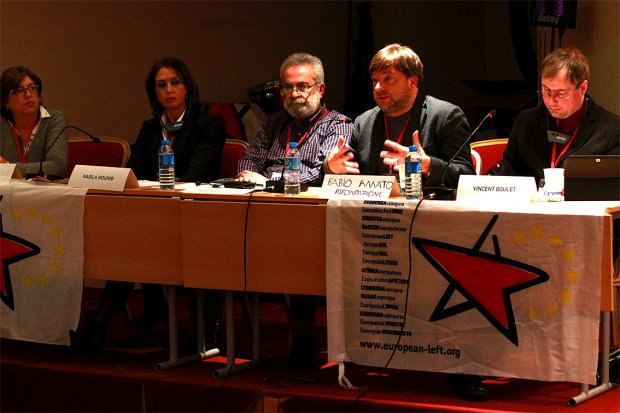
In this context the need arose to define a strategy in the struggle of the left against a common enemy with its three faces: imperialism, neocolonialism and neoliberalism. One of the pillars of such strategy would be the battle for secularism, which is not comparable to atheism, but to the separation between civil state and religion, leaving this last one to the private sphere. In short, claim the philosophy of light against the obscurantist views of religions.
At the root of this increase of fundamentalism, populism and fascism, the consequences were also pointed out that are caused by the capitalist globalization, international military interventions and the neo-colonialist wars that have been provoked in the Middle East.
The consequences of the systemic crisis and austerity policies have also contributed, increasing inequality, precariousness, dismantling public services and causing social and territorial fractures. That is translated into the deepening of the poverty and social exclusion. The populism and the extreme right take advantage of the situation, just as they have done it after the recent terrorist attacks in Paris and in Copenhagen, which they have been able to use as there is growing fear of terrorism among people. The Danish People´s Party has also attracted many supporters as they criticize the EU related austerity policies of the Danish Social-Democratic-led government and their effects. Today the far right in France heads the electoral opinion polls and in Denmark it overcomes 20 % of the votes. Fascism is strong in Greece too, despite the Syriza victory. And it spreads over Europe.
The exploitation of religion against the rights of women was another of the axes of the debate. Tunisia is an example of how these women who were in the streets, from the first moment, mobilizing for the democratization of the country, were the first betrayed by the new Government. Elections of October 2011 gave a large majority to the Islamists, with a low representation of the progressive forces. As a result the Islamists took advantage of the situation to cut women's rights and impose Islamic values in the new Constitution, introducing major divisions between men and women. In fact stressed the threat posed by religion for ethical values and equal rights.
The various speakers who participated in the discussion analysed the situation considering how to carry out the struggle for the democratization of the society, with universal and equal rights for all. In addition to secularism, with the defence of the civil state separate from the Church, and the need for a cultural revolution against obscurantism, special emphasis was placed on the solidarity and the fight against austerity that leads to increasing inequality, exclusion and marginalization, especially among young people. One of the routes for progressive transformation, as it was underlined, is to involve the young people in order to fight for their rights and lead this change. Rights for workers, social services and the principles of freedom were some of the claims they called for.