News / 09 Jan 2017
Go to newsThe Party of the European Left analyses the advance of the far right in Europe during a Forum in Madrid
The far right advances in Europe. In 2017 there will be elections in France and in Germany. In France, the Front National of Le Pen leads the polls and everything points to the fact that French people will have to choose between the far right, represented by Fillon, and the extreme right of Le Pen. In Germany the party of far right, Alternative for Germany, carries on winning positions vote after vote.
The left has the responsibility of giving compelling alternatives against the new growing fascism
The far right advances in Europe. In 2017 there will be elections in France and in Germany. In France, the Front National of Le Pen leads the polls and everything points to the fact that French people will have to choose between the far right, represented by Fillon, and the extreme right of Le Pen. In Germany the party of far right, Alternative for Germany, carries on winning positions vote after vote.
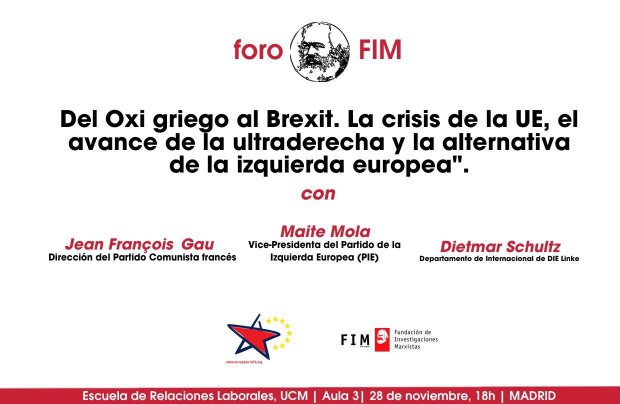
Against this backdrop, members of Die Linke and of the French Communist Party (PCF) featured in the forum organized by the Fundación de Investigaciones Marxistas (Foundation of Marxist Research) and the Party of the European Left (EL) that took place last November 28 in Madrid with the title “From the Greek Oxi to the Brexit. The crisis of the EU, the advance of the far right and the alternative of the European left”.
Dietmar Schultz, of the International Department of DIE Linke, exposed how fast the far right grows in Germany, surprising everybody. And it does so in a very intelligent way: they have updated their speech and present proposals which could be seen as coming from the left-wing, such as their position against U.S. military bases. This creates some confusion to the point that sometimes it happened that people on the left have participated in their manifestations and voters of the far right have come to back the calls of the left, illustrated Schultz.
It is in the east of the country where they become stronger, among the losers of the unification, explained the representative of Die Linke, who pointed to the difference of wages and discrimination that still exists between the two Germanys. Indeed, even the name of the party Alternative for Germany (AfD) is appealing. Facing this situation, he stressed, the left has the responsibility to provide compelling alternatives.
The member of Die Linke also argued that the solution is not to break with the European Union but to use it as a bulwark against the nationalism. He added that nowadays in Germany the war become a topic "and we are in a dangerous situation as we had not been since World War II, with a strong campaign against Russia".
Jean François Gau, member of the leadership of the French Communist Party, explained the scenery in France. He spoke of the process of the right wing drifting towards the extreme right, after the election of Fillón, “an ultranationalist in the economic and the social issues”. According to all the forecasts, in the upcoming presidential elections he will face the National Front of Marie Le Pen, who works for the standardization of the party that she inherited from her father. Le Pen wants to lead a modernized extreme right which does not allow fascist aesthetics, skinheads or other similar symbols in its demonstrations.
In this context, Gau criticized sharply that meanwhile the right wing has chosen a candidate for the right for doing politics of right, the left is unable to unite in order to face the danger that approaches. In fact, he said, the French left is divided with 4 or 5 candidates. He also said that the PCF has worked for having a candidate of a broader left to face-off against the right which means that they have refused to submit a candidature "to support Melenchon, despite its populist campaign".
The vice president of the EL, Maite Mola, was unable to participate in the meeting as she had to fly in haste to Cuba in order to represent the Party of the European Left in the posthumous homage to Fidel Castro in Havana.
Original Language / ES