With great vehemence, patriarchy is leading its static warfare along the trenches of gender norms. The consequences are dramatic: there is an ever growing divergence between men’s and women’s incomes, poverty among women is increasing as is the destruction of the environment, while scenarios of violence are pervading both the international and the personal relationships – with all this now to be topped by the economic crisis. Critique of patriarchy and critique of capitalism belong together. That feminist issues are neglected if not ignored also in the contexts of the Left has not only been known since the legendary throwing of the tomatoes in Germany’s 1968-movement.
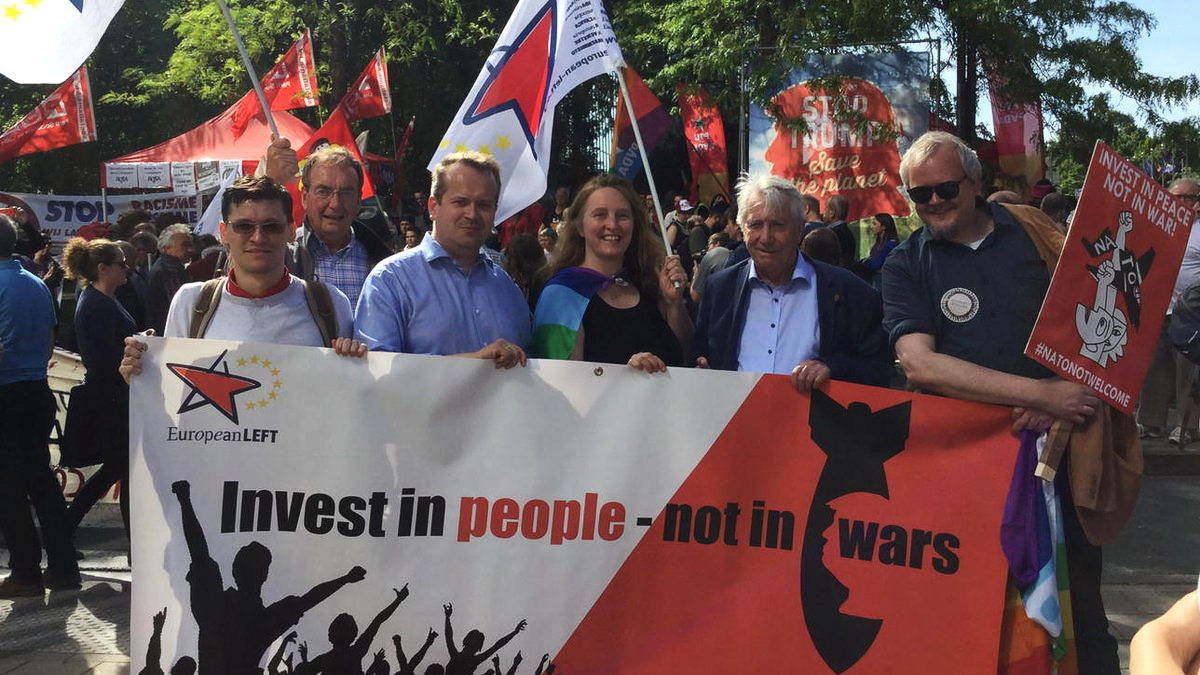
“How Feminist is the Left? – How Left is Feminism?” was the motto of a conference of the feminist network of the EL (EL Fem), which was organised by EL FemA (the Austrian women of the EL Fem network) on 20 and 21 March. The EL Fem network is constituted of women from left parties and of non-party allied women from all over Europe. This diversity was reflected in the contents brought up by the 150 participants who had come to Vienna from all different parts of Europe and presented left demands from a feminist perspective.
On the eve of the conference Frigga Haug (Germany) prompted with her utopian “Four-in-One-Perspective” a lively exchange of ideas. Her speech focussed on issues, such as the just distribution of paid labour, family work, care work and chances of development (cf. also http://www.kpoe.at/home/frauen.html ). While these four areas had for a long time not been regarded as being interrelated, Frigga Haug provided a compass that allows viewing the different aspects within a common context. This bundling, so Haug, is critical, even revolutionary, while each area taken for itself in isolation tends to lose weight or even to become reactionary. Relations between the sexes have to be considered as relations of production. This feminist insight has to be taken to the den of the Marxist lion. Four hours of paid work, four hours for the reproduction of life and nature, four hours for the development of one’s own potential and four hours for political interference – this fulfils the day with eight hours of sleep and meaningful activity.
The question remains: What to live for? In this context, the basic income guaranteeing a safe existence, just distribution of financial resources, distribution and dissolution of the profit-oriented organisation of labour were discussed. And again and again the question was raised where in Marxism the women’s question got lost.
On Saturday and Sunday lively discussions in the panels and the workshops followed the speeches by Mária Jóo (Hungary) on Post-Socialism and Feminism; by Tove Soiland (Switzerland) on Gender or on the Adaptability of Subversion; by Maureen Maisha Eggers (Germany) on Unmistakeable Experiences - Interdependences of Racism, Sexism, Classism in the Political Arena and by Manuela Tavares on Feminism and Marxism – an Unviable Alliance? New Challenges for a Radically Left Feminist Ideology.
(Reports, presentations and other documents will be online soon.)