Statements / 15 Dec 2008
Go to newsEuropean workers' and youth mobilisation, against the economic crisis
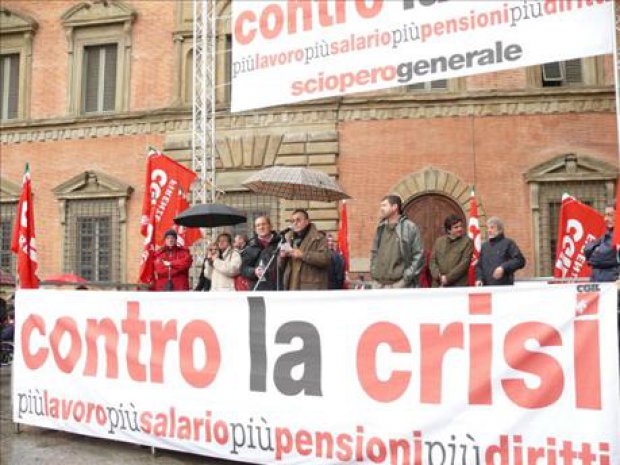
It may be a mere chance that Italy and Greece are the only two countries where the unions called a general strike. Beside the mobilisation of workers, an unexpected and strong movement of students and young people was on the squares.
The union CGIL in Italy has been successful: large demonstrations all over the country and strikes on the workplace that outnumbered the amount of the union’s members. The strike was rather difficult, for it was declared in times of a deep economic crisis, where thousands of workers have already lost their jobs, and it was supported by the alternative Left only. For the first time after years the CGIL leaders took this decision breaking with other big unions and the Democratic Party, and carried on with the grassroots organisations only. It’s true that for years the CGIL has not had any “party of reference”, but it’s also true that the autonomy of trade union goes far beyond this issue. It concerns the autonomy from government, institutions, political forces, but it is also related to its strategic role and capacity to defend and represent the workers’ environment, which today is particularly fragmented. The clash with the employers and the government, the division between CGIL and the other organisations, in fact is about the defence of collective agreements as opposed to the individualisation of the employment relations.
The struggle against the European working time directive is based on the same issue. The economic crisis has already generated disasters not only with regard to the living conditions of workers that have been precarious and determined by low salaries, but also referring to the battle amongst the poor. The first ones to be sacrificed in the closing factories are immigrants, the young and precarious, finally women, in the attempt to oppose single interests to everybody’s rights.
With this strike the CGIL has tried to say no, to explain that only by inverting the policies that have originated the crisis we can get out of it; meaning that we need more rights, higher salaries, decent jobs for everybody. The joint movement, which tries to unify all workers, is asking the government for social buffers for those who have unlimited working contracts and for those who experience all kinds of precarious conditions. In face of the crisis all must be protected and keep their jobs. If we loose this fight, after the crisis we will be poorer and weaker and will have lost the fundamental right to unionise and defend our rights. Thus, the national strike’s success is essential, and represents only the first step on the difficult way of reunifying the workers.
Attention should be paid to the youth movements and their circumstances in Italy and Greece. An "anomalous wave" has splashed over Italy, and in Greece riots have started after the killing of young Alexandros Grigoropoulos by the police. For months now, students and university researchers in both countries, as well as in Germany, France, Spain and Portugal have been fighting for the right of education and against the privatisation of schools and universities as predicted by the European Bologna process. Now it’s as if the worst has come to the worst, if the awareness of the everlasting precarious condition that all these young people are condemned to, has exploded and risks determining an irreversible intergenerational break.
The strikes in both countries are a chance for dialogue and conjunction in a situation where total separation is close. The effort must continue and needs time and concrete proposals – and it’s up to politicians and to the Left in particular.
We, comrades of the Party of the European Left, feel this great responsibility. Our electoral platform for the upcoming European elections goes far beyond the dimensions of a programme because it strives for the ambition to indicate the way out of this economic crisis with a new development model that pays attention to environmental issues, demands another role for institutions and the use of public money, and establishes new rights for workers and the younger generations.
Our participation in the unions’ mobilisations, such as the demonstration in Strasbourg on 16 December, is part of our social and cultural work that we continue to do in every city, in every quarter of the European continent.
Graziella Mascia, EL Vice-Chair