The press festival “Volksstimme” that took place in Vienna on August 30 and 31, was part of the European Left campaign against precarity. In the midst of its national election campaign, the Communist Party of Austria considered the activities of the EL an important contribution for the fight of a political change in a social direction. The left parties in Europe are tackling this burning problem in light of exorbitant raises of costs of living: it’s a situation; where rents are rising even more than the average increase of costs; where hundreds of thousands of Austrians - many of them women or young persons – don’t have regular jobs or decent salaries; where many people, especially old age pensioners, students and single parents are facing the problem of not being able to heat their flats properly in the coming winter, because of the rising energy prices; and where families have to cancel their annual holidays because they are unable to finance them.
The idea that there is a force in Europe that speaks up against this brutal neoliberal development is encouraging and shows that not only in Austria but in the whole of Europe a political party exists that strives for alternatives to the neoliberal way of life.
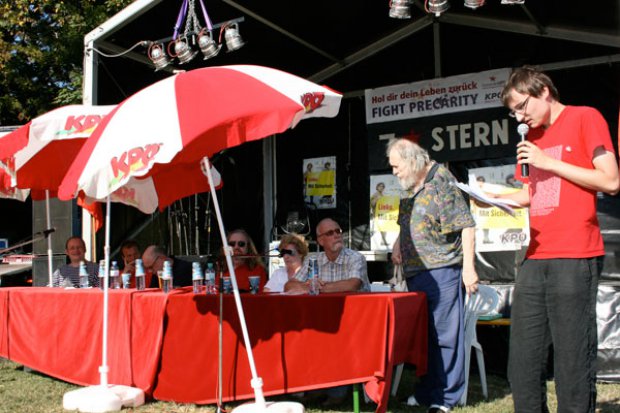
Over 60,000 people came to the press festival and had the opportunity to get in contact with the European Left Party - present with its own stall and a stage – as well as with representatives from EL member and observer parties, such as Die Linke and DKP.
The activists distributed flyers with the main points of the action programme and organised a roundtable discussion, where members of the EL, trade unionists and young people took the floor.
The EL-FEM working group in Austria had an informal discussion dealing with the special situation of women and precariousness.