TOGETHER WE SAY THAT ANOTHER EUROPE IS POSSIBLE

News / 29 Jul 2016
Go to newsForo de São Paulo explains at the EL Summer University the processes of integration in Latin America and the neoliberal counteroffensive
The relations between the Party of the European Left and the Foro de São Paulo consolidate and deepen. An example of that was the participation of Mónica Valente from the Executive...
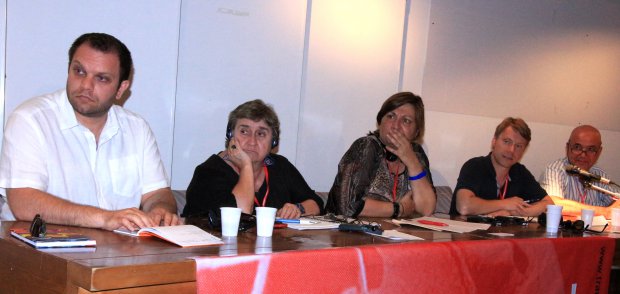
The relations between the Party of the European Left and the Foro de São Paulo consolidate and deepen. An example of that was the participation of Mónica Valente from the Executive Secretary of the Foro de São Paulo in the Summer University of the European Left.
It was an opportunity to hear first-hand about the general situation in Latin America and in Brazil in particular, from imperialist offensives to the coups of the new generation, replacing the military coups by financial and legislative ones with media artillery. Also of the regional integration model. The introduction was done by Martin Shirdewan from the Rosa Luxembourg Foundation, who also chaired the debate.
Mónica Valente explained that from the victory of Hugo Chavez in 1998 and shortly after, in 2002, the victory of Lula, a horizon opened in Venezuela and Brazil, which quickly spread to the continent in countries such as Argentina and Uruguay where the left won three general elections, as did Evo Morales in Bolivia and Correa in Ecuador, two elections in El Salvador and in Chile, one in Panamá, in Honduras and in Paraguay. She did it in a panel shared with Maite Mola, EL Vice-President and responsible of the international relations of the European party, who opened the debate by denouncing the attempts to destabilize Latin America and the attacks against the BRICS in general and Brazil in particular.
Communist, socialist, social-democratic and progressive governments all spread over the region, told Valente. The governments of the left impose a new concept: first distributing to people and then to growth, instead of starting with growth as it has been done before. Social measures were implemented, health was improved, the right to housing and a minimum wage. In 11 of 17 countries inequality has decreased. And regional integration bodies were created, such as the UNASUR and CELAC, “so important today, in these times of destabilization, to mediate and prevent the triumph of the United States impositions¨.
There was always an offensive of imperialism trying to destabilize leftist governments, according to Mónica Valente. Coup attempts in Venezuela, in 2002, in Bolivia in 2006, in Ecuador in 2007, in Paraguay in 2008 and in Honduras in 2012. But the offensive has intensified in the past months with the victory of Macri in Argentina, the Venezuelan opposition in the parliamentary elections in 2015 and the institutional coup in Brazil. According to Valente, this is joined by the impact of the global economy, among other factors.
The Executive Secretary of the Foro de São Paulo also made a self-criticism. She explained that in her opinion we should have been more aggressive in the integration processes: “we have a clean energy, good climatic conditions, natural resources, if we were more aggressive in terms of energy and infrastructures, perhaps we wouldn’t have the problems we have today and the impact of the global economy wouldn't have affected us so much”. It would also have helped to go forward with the creation of a South Bank or funding from the Mercosur to strengthen national production changes, she added. And also strengthen the BRICs and a bank of help for the countries.
Mario Consolo, PCR responsible for Latin America, explained how progressive, revolutionary and centre left governments were being formed since the Zapatist revolution in 1994. He spoke on the integration and cooperation processes in both production and oil consumption, such as Petrocaribe, financial as was the South Bank project, ALBA, CELAC and at the media level, Telesur.
He also spoke about the imperialist counteroffensive against the Latin America integration alternatives, both through the increasing militarization in the region – reinforcing bases and opening new ones -, as well as the free trade agreements, which he called the “new caravels as those with which Columbus wanted to conquer America”.
When asked about what to do, Consolo posed three points: the first being the fight against treaties “written directly by the multinationals with hundreds of lobbyists in Brussels”, the second being the need to develop relations with union forces at international level, and the third one being the democratization of the mass media, which builds the foundations for todays’ coups.