News / 27 Jul 2016
Go to newsThe left debated about alternatives concerning the future of European integration
This European Union does not satisfy anyone, neither to the transformative left, which debates on another model based on solidarity, nor to the architects of this Europe of austerity working to deepen and consolidate their neoliberal model, limiting more and more the fiscal competencies of its member states. For that the presidents of the five main institutions of the European Union, Jean-Claude Juncker (European Commission), Donald Tusk (European Council), Jeroen Dijsselbloem (Eurogroup), Mario Draghi (European Central Bank) and Martin Schulz (European Parliament) wrote a report called “Completing Europe’s Economic and Monetary Union” marking a roadmap to develop neoliberalism. It’s a ten-year plan, which began in 2005 and aims to achieve its goals in 2025. This document is known as the “The Five Presidents’ Report”.
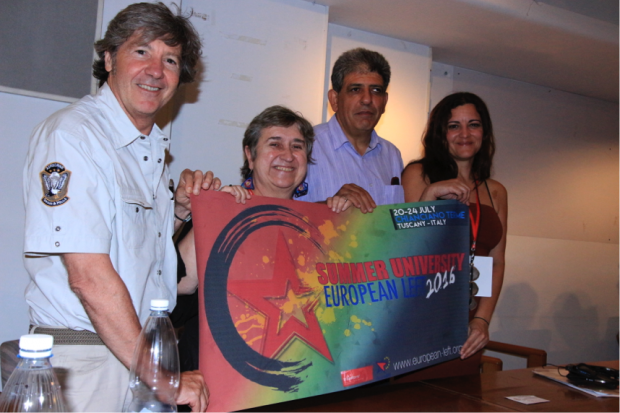
About this report, the future of EU integration and the alternative of the left were debated in the Summer University of the European Left, in Chianciano Terme. Roberto Morea, from Transform!, presented the session talking about a “process of ademocracy” that is advancing not only in the EU but in many European countries, imposing the concept of “governance without citizens, without democracy”. He recalled the recent example of the French socialist government who approved the Labour Law, preventing its debate in the Parliament.
Maite Mola, EL Vice-President, began her intervention criticizing the little known report and its technical nature, in which the five presidents, not caring about the poverty and precariousness in which people live, are worried about their financial crisis, competitiveness and defence of the euro rather than by the needs of the social majority.
She introduced four points that are to be developed with the report; the Economic Union, the Financial Union, the budgetary Union and the Political Union, and commented on the important work the left has to do by elaborating proposals not only in the large and medium term but also in the short-term.
Two lines of work to follow were then specified. The first was related to the need to try to occupy the institutions with fronts, not necessarily new parties but broad fronts with unions and social movements, who criticize this European Union. The second consists in defining a common struggle “because we have common problems such as the disappearance of public services (…) and yet we fail to do the fight against one of the main enemies which is the European Union”. Then, she added, we have to find out what to do and how to build a regional model, and how and with whom to build wider fronts.
Neoklis Slikiotis, MEP from Cyprus and Vice-President of GUE/NGL, explained that the ideology that hides behind the report doesn’t add anything new and intensifies the destruction of the workers’ rights and collective agreements through the dismantling of the welfare state and increasing inequalities. Therefore, he stressed that the EL must question not only The Five Presidents’ Report but the structure that constitutionalises that policy and the common economy that destroys the economy and democracy.
He explained that the memorandum remains unofficially in his country as well as the situation of unemployment and unregulated part-time work endured by its people who suffer from neoliberal attacks for over three years.
Regarding the European project, the MEP from Akel, party that retains 25% of the votes in his country, called for the return of the national currency: “we demand the exit of the EU so our economy and fiscal competencies go back to the State”. We need an international way-out for workers and for the European left parties. We need a strong and united left which based in the mass movements, cancels the neoliberal model an antidemocratic structure of the European Union. He stated that the solution isn’t always easy but we must discuss all possible alternatives.
Marisa Matias, also Vice-President of the European Left, disagreed by saying that although today the discretion is the only concept operating in Europe, she cannot accept the argument that we cannot change Europe. We can change it but we have to decide if we want to fight for it or not. We can do it if we have power to do it. The problem is we don’t have it.
We have a clear diagnosis and we know what we want: peace, social justice, etc. but we have to give concrete solutions to the concrete problems of the people and not just keep in criticism or global alternatives”. She added that the people know we are very good at criticizing and that is why they vote for us to be in opposition, however, if we don’t present concrete alternatives and a will to build and govern, they will never vote for us to govern”.
The Portuguese MEP from the Left Bloc insisted that we cannot leave any empty spaces and we have to explore all contradictions of the capitalist system such as the contradictions the far-right has with capitalism regarding the question of emigration, since the capitalism needs immigrants to lower wages. She concluded arguing that in these moments we don’t have the strength to be on the offensive, but to “work on the defensive, from resistance, which is a strong weapon”.
In the debate that followed the interventions, an alternative model for the left was once again addressed with the question if it would come with a refoundation from inside the EU or through another regional integration model. For Maite Mola “this model has no solution. Try to change it would be a waste of time because nothing can be changed inside capitalism. But I am for a completely different regional model from the one we currently have and for internationalism”.
From Sinn Fein, MEP Matt Carthy made a call for the left to resist together to the fiscal laws, explaining they created a scenario in which the left can arrive to government but not to power, as it happened in Greece, and left policies cannot be implemented. He was critical about the time parties spent criticizing Syriza last year, instead of working to change things in their own countries. He also spoke about Ireland, and The Five Presidents’ Report, saying that in Ireland don’t know the name of any of those presidents but they know who Barroso is because he’s the face of austerity.
As we’ve seen, the solution isn’t easy but the debate is open and the discussion will keep going on.