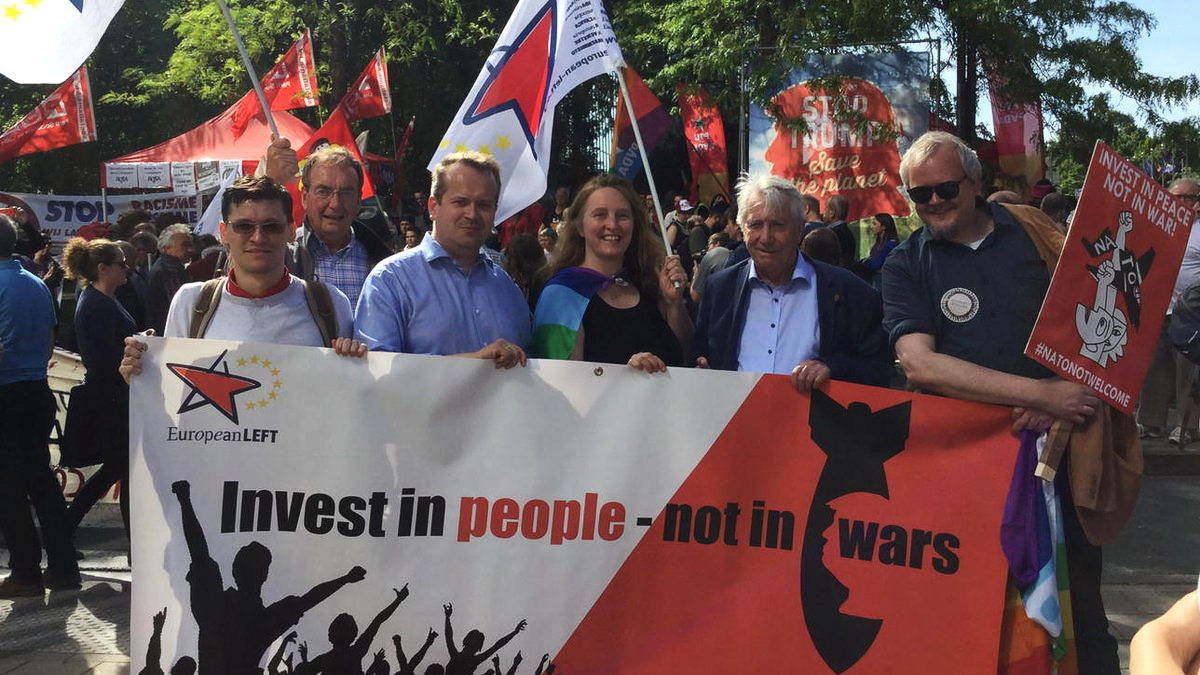
The opening session of the 11th Summer University of the Party of the European Left (EL) took place the past 20th of July in Tuscany, with more than 260 participants from 31 countries. During the four days, Chianciano Terme is the place where the European Left discusses and analyses the latest events, politically, economically and socially, few months before its fourth Congress taking place at the end of the year in Berlin.
Fabio Amato, member of the direction of the Communist Refoundation Party (Italy), opened this school of analysis, recalling the 15 years since Carlo Giuliani was killed because of Carabiniere’s firearm during the protests organized by the Genoa Social Forum against the G8 summit happening in that city, the disobedience protest against neo-globalisation. Amato insisted in the need to keep saying that another world is possible and needed. He explained that today the European Union is based on free exchange markets, conflicts, inequalities, precariousness, witnessing the rise of fascism, far right and racism. According to him, we see it more as a problem than as a solution and that is why we need to promote an alternative.
Maite Mola, Vice-President of the EL, was the first to take the floor in the opening panel dedicated to Europe after Brexit. In her opinion, the decision made by the British people shows the disapproval towards this capitalist European Union. However, we need more time to understand the real outcome of their exit. At this point we will only start seeing the effects of the economy on the EU population living in the United Kingdom.
The referendum in the UK took place on the past 23rd of June, just three days before the General Elections in Spain. On the 24th, more than twelve million Spaniards stood up listening to the results of this consultation. These announcements were accompanied by the reactions of the presidential candidates of the Socialist Party, the new right of Ciudadanos, and the traditional right Popular Party, all expressing in different words, the same concept of democracy: we can not let people make decisions on important issues. All these messages have crystallized to cultivate the fear of what could happen if the left won the elections.
Faced with this Europe after Brexit, Maite Mola raised two concerns in the form of interrogations: why does the right and the far right occupy such a large space in Europe and what are we doing wrong at the left? Do we have a project and are we capable of communicating it? She concluded by saying that the solution is not to reform Europe but to build another European regional model.
For that refoundation to be credible we need to break with the past and the only solution for that is to disobey to the EU treaties, to the ECB, to the Troika and to independent authorities. That has been said by Haris Golemis on behalf of Transform! denouncing that national parliamentarians have to submit bills to the goodwill of the European Commission.
For Golemis, the Brexit result is part of a national and international complex context, that goes from the refugee crisis and terrorism, to different elections that have taken place this year in Europe, the French Nuit Debout and the mobilisations against the labour reform and so on. The Brexit reveals itself as the most big problem of the European project structure.
He insisted, just like Fabio Amato, that today the EU is a project put into question everywhere because of its lack of democracy, the austerity, the inequalities and imperialist wars. The radical left must transform this rejection in an alternative economic plan, which begin with constructive questionings. According to him, for that we must analyse the possibilities of creating a big alliance between parties, trade unions and social movements, including the social democrats that continue to position themselves against neoliberalism.
The PCR Italian MEP Eleonora Forenza also defended the idea of reforming Europe through the democratisation of the institutions because the European Union is solely a market and a device to protect the ruling class without caring about the workers. She concluded saying that the goal is to build the struggle, the social conflict and the left parties.