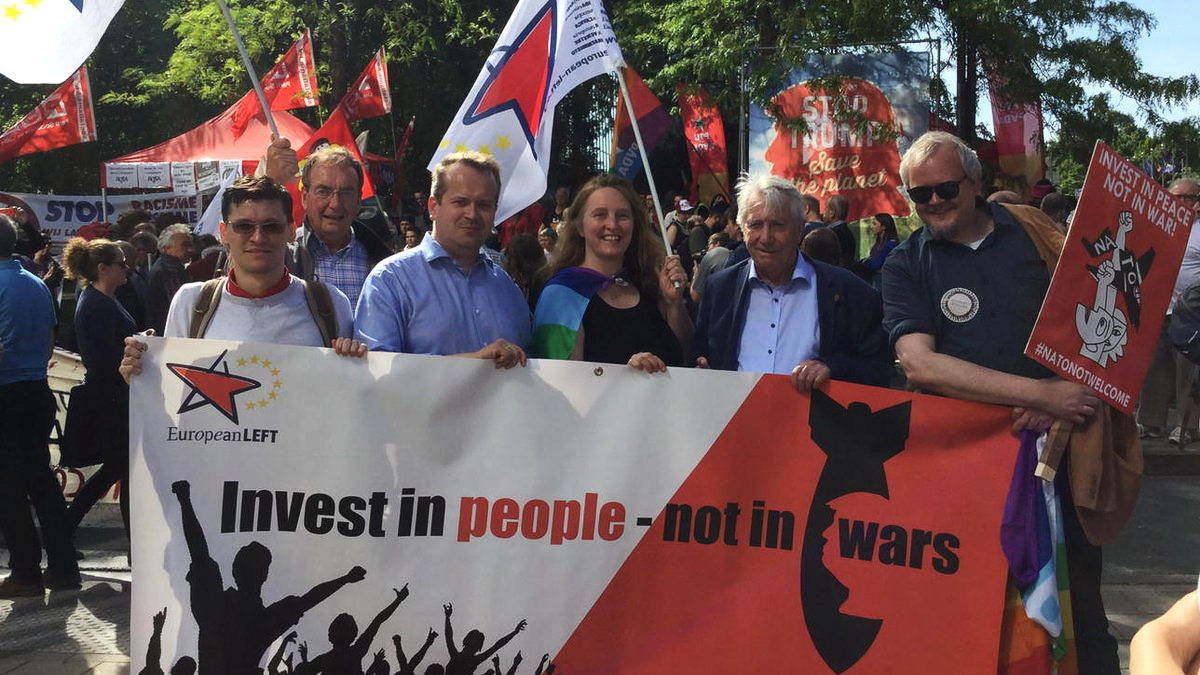
The political, economic and social situation in Europe after the European elections appears to be very dynamic and unstable. Explaining the situation today, we could say that we are on the brink between an eclipse of politics and, on the other hand, a rebirth of politics. Europe witnesses today a deepening of the political crisis which probably will take two different ways: There is a danger of a further crisis of politics with an even greater alienation of the masses from it. And there is the possibility of a reconstruction of politics with the recovery of a major political role for the masses in Europe.
This analysis may be very important for us. Because I think the intervention of a political force like ours can in the future have bigger consequences in one sense or the other. The very instability of the current political situation gives us the chance of a greater intervention, of more influence. At the same time our exposition to the dangers is bigger. We can rapidly become main actors on the political scene of Europe, but we also run the risk of being marginalised in the political life of the continent. For this reason I think that the birth of the European Party has been an extraordinary event. It is offering us an exceptional chance. A trend that emerged in the last European election proves this analysis. The member parties of the European Left Party achieved good results. Some were very positive, there are also some exceptions, which the comrades will explain in more detail. The same is to be said for the parties which form the GUE/NGL Group in the European Parliament.
Generally speaking, I think the results of these European elections are reflecting three main tendencies:
First, we can see a recovery of the strength of the left opposition. This is a left opposition because of its political contents. An opposition to the imperial war in Iraq on one hand and to the neo-liberal policies on the other. This tendency is showing itself not only in Europe, but also - for instance - in India. We saw it during the recent national elections in France and Spain. In the European elections this tendency manifested itself in the opposition against right-wing governments. But it went also against labour, socialist, social democratic or centre-left governments when they were carrying out neo-liberal and war policies. The Blair government was hit for of all these reasons and the Schroeder government defeated for some of them. So we can say that in Europe there is a mass opposition of the left.
Second: There is another kind of opposition which goes not only against government policies but against the political system. It is manifesting itself in the alienation of the masses from politics. This tendency cannot be defined as indifference to politics. It is a new political phenomenon, contradictory and ambiguous, which assumes the form of abstention from the vote or of protest vote. And the protest vote can be given to different political subjects, sometimes even to right-wing political parties. But it can also express itself as in Britain through the vote for the Liberal party. It is a vote expressing itself in various ways, depending on whether the left is in government or in opposition. Where the left is in opposition this vote is absorbed by the overall vote against the right-wing government. Where the left is in government, it assumes the form of a protest vote. That is an important political problem for us.
Third: There is an opposition against the construction of the political institutions of the present Europe, the kind of Europe that is being built for years. This does not manifest an anti-European attitude. This opposition is not necessarily a nationalist one either. In this attitude many factors and elements are combined. It usually takes the form of abstention from the vote. This seems to be the case particularly in some Central and East European countries but not only there. In many other countries the turnout has been very weak. It is often the lower social classes that have this attitude. Italy seems to be an exception. But there, it is true, the poll has been increased by the national situation - the growing opposition to the right-wing Berlusconi government. The high participation shows the protest against this government. Besides, we have to see that in many places of Italy we had local elections on the same day.
So, generally spoken, the phenomenon of a distance of the people from the construction of Europe exists. Some of the three tendencies described can be summarised in this way. For different reasons the social Europe has got into opposition to the political Europe. Our political initiative, our political action should start from here. When we try to unify all these different kinds of opposition into a left class opposition we have to work out a political operation. We have to enable the European Left Party to accomplish this. It is full of chances and risks. But the real danger is that the people in Europe will have a more and more discouraging perspective. Let me give some examples:
For instance the change of the EU-Commission Chairman. Prodi was not good, but Barroso is even worse. Barroso is the personification of a pro-American attitude and a neo-liberal policy. With him neo-liberal policies will take over the rule of the new European Commission. And that at a time when neo-liberal policies are in crisis, are declining in all European countries. It seems that Europe is the last actor to realise this. It encloses itself in a neo-liberal fortress. At the same time in Europe, and not only in Europe but all over the world it is obvious that neo-liberal policies have failed.
Second, in the European Parliament the conservative forces regained the majority, which is a pity in itself. But even worse is that the moderate Left is going for compromises with the conservatives. There is only one parliament in Europe where there is no opposition: the European Parliament. Even for the election of the EP President an agreement has been reached between conservatives and leftists.
Third, the new European constitution has been radically criticised by all peoples of Europe. But instead of reopening the debate on the constitution, it is closed. And in the end of October the treaty will be signed. But, as you know, this is a constitution which institutionalizes the market. It is a regression compared with all constitutions of the European states adopted after the Second World War. By this even more masses will be alienated from the European process and from politics. Therefore, the strength of our intervention depends on our capability to oppose this tendency. To do this, we have at least two opportunities.
The first one is given to us by the growth of the social movements in Europe. I have in mind the forces critical of globalisation which will stage the next meeting of the European Social Forum (ESF) in London. This will be an important event for us. The anti-war-movement has demonstrated its ability to make itself heard. But the social struggles and the workers struggles are also achieving important results. I think we should devote one of our next meetings to the analysis of the social conflicts in Europe. That is to say, to the situation of the struggles and the trade unions in Europe. There are important differences from one country to the other. And there is the huge problem of unifying these struggles.
In Italy we have a new season, as we say, of social conflicts. Through their struggles workers for the first time after 20 years are gaining complete achievements. And nevertheless the situation is not easy. Sometimes in the unions you have leftist political positions but moderate positions in the social field. Or it is the other way round. I was very much impressed by the German IG Metall initiatives which put into question the historic relationship between the SPD and the unions. At the same time this very union signs an agreement on a 40-hours working week. In Britain some trade unions think about stopping their financial support for the Labour Party. They are looking out for other political partners. This is a new phase in the relationship between social conflicts, trade unions and politics. It gives us another opportunity, a background for our intervention. This is a new situation loaded with chances and risks.
In Europe a pendulum is swinging. Where the Left is in opposition, it profits from the popular protest against the right-wing governments. Big hopes are put on us. But then the votes go to the moderate Left. If it gets into government and carries out a neo-liberal policy, it causes a crisis in the relations with the popular masses, and the left is divided. We have to stop this logic of the pendulum, to create an alternative to it. This can be done in three directions:
- We shall be present in the social movements. We shall be growing with them and within them.
- We shall build and strengthen the EL, win new parties and parts of the movements, for instance the trade unions, for it and its activities.
- We shall organize our own political campaigns as EL. We need an agenda of such political action.
These should deal, firstly, with the problems of war and peace: We shall demand to call back all foreign troops from Iraq.
We could promote together with others a peace conference for Palestine. This could be carried out in two parts - the first one in Ramallah, against the Wall, and the second one in a European city on the Geneva agreement.
A second campaign should be focused on social and environmental issues. I think that a campaign on wages and pensions in Europe could be particularly effective. At the same time we could think about a European conference on work and employment. In many European countries we have now a dramatic split between the situation of traditional workers, who are getting a more or less regular salary, and those working under precarious conditions. I am thinking of a European conference trying to unify the two labour worlds, focussing on wages and workers' rights.
Thirdly, a campaign on the European constitution. In this case we should try to make a quality leap in the relationship between the countries of Western and Eastern Europe. The European left parties should get closer to the reality and the experience of the East European countries to overcome the differences and difficulties that exist. This would also be useful for the growth of the European Left Party itself. I think a common point on which we can start this work, is the opposition to this European constitution. Here we should focus on the idea of a European construction from below, of a constitution for the peoples of Europe. I think this could foster our growth. It could be useful if we contribute together with the European Social Forum to a European demonstration on the occasion of the signature of the Constitutional Treaty. We could call an assembly of the European Left Party on a rewriting of the European constitution some days before the demonstration.
Together with these three campaigns we will have to discuss - during our session tomorrow - about the tools by which we will organise this work. One thing I allow myself to say in this regard is that we should be particularly attentive to the women's issue. Because when thinking about the construction of our party, the tools of its work and its political initiatives, I think that women should play a central part.
Thank you for your attention. Sorry for having talked longer than scheduled.