The EL analyses the possibilities of the political and social emergent forces and the reasons and consequences of the European scepticism
In addition to the advance in the document of the Congress and the new structure with which the Party of the European Left (EL) will be provided to work from now on, the EL Council of Chairpersons, gathered Friday July 1 in Paris, analysed and assessed the new tectonic movements on the ground in which the European Union stands, as there has been the vote of the United Kingdom, on June 23rd , in favour of the Brexit, and the general elections in Spain last June 26th , among other topics, such as the TTIP and other treaties of free trade, the fight against the labour law in France and the increasing authoritarianism of the French Government, as well as the danger of the repetition of the elections in Austria which this time could give the victory to a far-right Government in the heart of Europe.
On the Brexit, the EL respects the vote expressed through the voting urns and at the same time points out some warnings and dangers. Concerning warnings, one of it was the rejection of a majority to a neo-liberal Europe of austerity which mandates against the interest of the peoples, and the need for the European Union to understand the consequences of its policies.
The impact of the Brexit
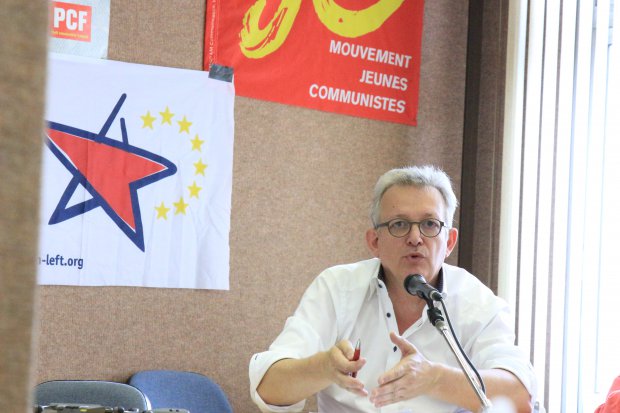
The rejection of the British to the European Union is not comparable to the NO that French gave to the Constitutional Treaty in 2005. The French referendum was a battle of the left against the neoliberalism of the Treaty, while the "NO" of the United Kingdom is marked by despair and it is not progressive, clarified Pierre Laurent.
Cocnering the dangers, one of it is the fact that it has been "a vote marked by the strength of an ideology that feeds a nationalist rivalry which is very worrying for the future not only of the United Kingdom but throughout Europe" according to the EL President. He also added, the real danger of a contagion effect that the far right can build on. It does not create an alternative against neoliberalism but, on the contrary, an increase in rivalries. In response, he proposed intensifying the relationship of the EL with the progressive forces of the United Kingdom. He suggested the "sending of a delegation that will go to the meeting of progressive forces in the UK and Ireland, to be able to deepen our assessment".
Pierre Laurent outlined the position of resistance of the EL to this liberal EU and the work to put an end to the policy of austerity. It should be about – in short – "reconstructing Europe on the principle of solidarity among European workers protected by common rights, not only at workplaces but also vis-a-vis transnational companies and globalization".
Analysis of the elections in Spain
Regarding the general election in Spain, in which the polls were placing the candidacy of confluency of Izquierda Unida, Podemos and other political organisations, as the second force in the country, it was analysed what could happen with the results that, although they frustrated the awoken illusions, situated the left for the first time as a major emergent force with an important weight in the Parliament assembling 71 deputies and 20 % of the votes.
The general Secretary of the Communist Party of Spain, José Luis Centella, argued how the politics of fear practiced by all parties acted against Unidos Podemos, and how the shock caused by the Brexit three days before elections harmed the results of the left, along with the increase of the abstention compared to the previous elections of December 20. Nevertheless, it was valued very positively that now in Spain there is an important emergent political force to work with and which joins those of Greece and Portugal in the European scene.
Resolution against the free trade agreements
A strong battle envisaged is the one that has been waged against the free trade treaties, as the TTIP and CETA, which has an increasingly bigger opposition, especially in countries such as Germany and France, and which are at a very advanced stage of negotiation, especially the treaty with Canada. The struggle of the left, as Pierre Laurent explained, is to get the ratification of these treaties to be performed in each of the national parliaments, something that the architectures of the agreement are trying to avoid at all costs, due to fears of a rejection.
And thus this notion is expressed in a resolution (www.european-left.org) adopted by the Council of Chairpersons, which explains that the TIPP and CETA are much more than trade agreements; they are the way in which our economies could be governed, it will affect the standards and regulations of European and American citizens, food security and to services delivered to the municipalities, among other topics.
That is why the EL, through its resolution, urges the European Commission to stop all negotiation processes. It requires the ratification of that Treaty through each of the parliaments of the States members of the European Union and the European Parliament, and calls to oppose an interim application until a democratic decision is made.
Battles against the Law of the Work in France
Another current battle is the one that the trade unions maintain, with the CGT at its leadership, against the Law of the Work in France, how this law of labour de-regularization has divided the proper socialist party, the attempts of criminalizing the protest and the increasingly authoritarian position of the government which already applied the article 49.3 to pass its procedure to the Senate without the need to vote for it in the Parliament, debilitating even further the French democracy.
And another democracy that also might be weakened soon is the Austrian after the announcement of nullifying the last votes due to a formal procedure. If few weeks ago the party of the far right was on the verge of winning the elections in the second round, now after the Brexit it would be more likely for them to beat the ecologist candidate.
The diagnose of the situation was accompanied by a proposals on some topics will work on such as a European Conference on the debt and tax evasion for the beginning of the year; a seminar to combat the rise of the extreme right, which the PCF is working on; the battle against the militarisation of Europe; the Mediterranean Forum to be held next spring in Spain; the meeting with the Forum of Sao Paulo in just before the EL Congress; and the preparation of the Conference on Africa, among other topics.